
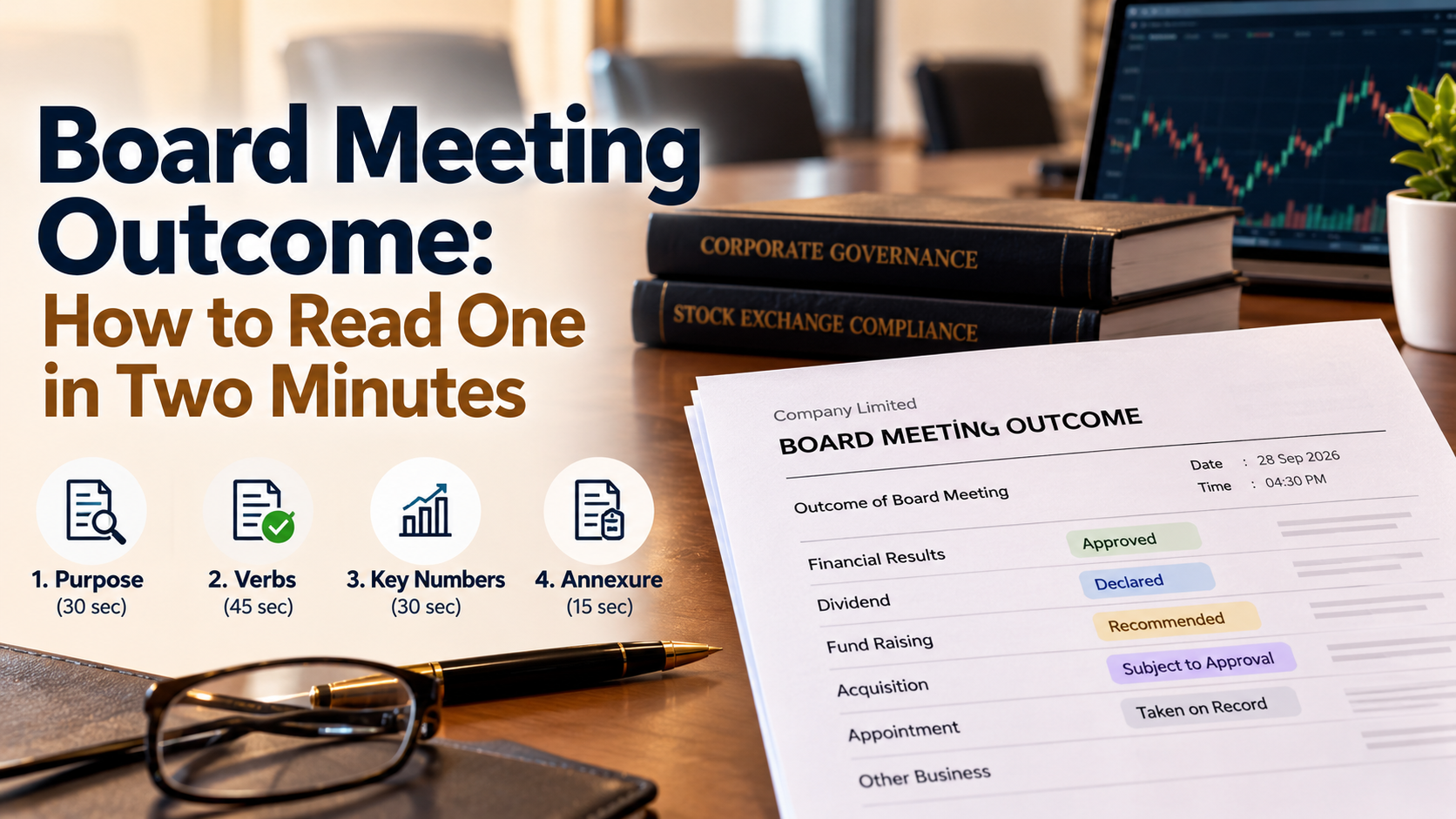
A board meeting outcome is the filing that tells you what a board actually decided. Read it in four passes: what the meeting was for, which verb was used for each decision, the numbers attached to them, and whether you need the annexure. Two minutes, and you will know what changed.
It is also the fastest filing a listed company makes, and that is worth understanding before you read one.
Why it lands when it lands
A decision taken in a board meeting has to reach the exchange within 30 minutes of the meeting closing. If the meeting ends after trading hours, and more than three hours before the next trading day starts, the company gets three hours instead.
Two things follow. A board meeting outcome filed during market hours was written in a hurry, because the rule leaves no time for anything else. And an outcome that appears in the evening was almost certainly a meeting that ran past the close, which is why results days end with a cluster of filings between six and ten at night.
Neither fact tells you anything about the company. Both tell you that this filing is the earliest confirmed account of a decision you will get, which is exactly why it is worth two minutes rather than a headline.
Pass one, thirty seconds: what was this meeting for?
Read the company name, the meeting date, the times the meeting opened and closed, and the title of the filing.
The title is the fastest filter you have. "Outcome of board meeting to consider financial results" and "Outcome of board meeting regarding appointment of director" need different kinds of attention, and you can tell which you are holding before you read a line of it.
One distinction to get straight. The intimation came first, days earlier, and said what the board would consider. The outcome says what it decided. If you are reading the intimation and expecting a decision, you are reading the wrong filing. We covered that pair, and the rest of the exchange feed, in Every Common BSE Filing Type, Explained in One Line.
Pass two, forty-five seconds: read the verbs
Board meeting outcomes are written in a formal register, and most readers try to decode every phrase. You do not need to. The verb in front of each item tells you how final it is.
| The verb | What it means |
|---|---|
| Approved | Done, within the board’s own authority. Results, borrowings inside existing limits, an acquisition it can sign off. |
| Declared | Done and payable. An interim dividend is declared by the board and needs nobody else. |
| Recommended | Not done yet. It goes to shareholders. A final dividend is recommended, and only the annual general meeting declares it. |
| Subject to approval of | Not done yet either. Read what it is subject to: shareholders, a regulator, a lender. |
| Taken on record | Nothing was decided. The board was told something, usually a report or a resignation that has already happened. |
That single column separates decisions from intentions, and it is the difference between "the company is paying a dividend" and "the company has asked its shareholders for permission to pay one in three months".
Pass three, thirty seconds: the numbers behind the verb
An approval without a number is not yet information. For each item that matters, find the figure the decision actually contains.
- A dividend: the amount per share, the face value it sits on, and the record date.
- A fund raising: the amount, the instrument, and whether it is subject to anything.
- An acquisition: the consideration, the stake, and the name of the target.
- An appointment: the name, the role, whether it is executive or independent, and the term.
- Results: the period covered, and whether they are audited or unaudited.
A dividend of five rupees means nothing until you see the face value beside it. On a share with a face value of one rupee, five rupees is five hundred per cent. Companies state both, and the percentage is the number people quote wrongly.
Pass four, fifteen seconds: do you need the annexure?
Most outcomes are two pages that point at longer documents: the results statement, the auditor’s report, the details of an appointee, the terms of an issue.
If the outcome answers your question, stop. If your question is about a number the outcome only names, open the annexure and read that one section. The point of the two minutes is to work out which twenty minutes are worth spending.
One real outcome, read in two minutes
Britannia Industries held a board meeting on 7 May 2026. Its outcome filing records that the meeting began at 3:30 in the afternoon and closed at 7:15 in the evening, after the market had shut, and it reached the exchange the same evening.
Four decisions, and the verbs do the work:
| What the board did | The verb, and what follows from it |
|---|---|
| Audited results for the quarter and year to 31 March 2026 | Approved. Final, and the numbers are in the annexure. |
| A final dividend of Rs 90.50 per share, on a face value of Re 1 | Recommended, "for approval of the Members at the ensuing 107th Annual General Meeting". Not payable yet. |
| The 107th annual general meeting, on 7 August 2026 | Approved, by video conferencing. |
| Register of members closed 1 to 7 August, record date 31 July 2026 | Approved. This is the date that decides who receives the dividend. |
Source: Britannia Industries Limited, outcome of board meeting dated 7 May 2026, filed with the exchanges.
Two minutes on that filing and you know the year is closed and audited, that a large dividend is proposed but not yet declared, that the shareholders vote on it on 7 August, and that the date which decides whether you receive it is 31 July. The last of those is the one people miss, and it is in the same filing as the headline.
Notice also what the outcome did not do. It did not declare the dividend. A reader who saw only the number would have the amount right and the status wrong.
The difficulty is rarely the reading. It is that these filings land at seven in the evening, on the day the board happens to meet, for whichever companies you follow. BSE publishes the filing. StockTool.AI’s plain-English summary is live one minute later, with the original source available for verification, for the companies on your watchlist, which you build by uploading your portfolio or adding stocks one by one. It is one of the modules on the StockTool.AI features page, and the app is on Android · on iOS
What the filing does not tell you
It records decisions. It does not tell you what they are worth.
An approved acquisition says nothing about whether the price was sensible. A dividend says nothing about whether the company could have used the cash better. A new independent director says nothing about whether the board needed one.
Those questions are answered, if at all, in the results, the annual report and the earnings call. The outcome tells you the decision exists, when it was taken, and what it contains. Read it for that, and take the interpretation somewhere else.
The two-minute checklist
- When was the meeting, and when did it close?
- What was the filing titled?
- Which items were approved, which declared, which recommended, which taken on record?
- What numbers are attached to each, and on what face value?
- Which dates apply: record date, payment date, meeting date?
- Is there an annexure you actually need?
Six answers is a complete first read. If you can write them down, you have the filing.
The short version
Read the title, then the verbs, then the numbers, then decide about the annexure. Approved and declared are done. Recommended and subject to are not. Taken on record is not a decision at all.
The outcome is also the end of a sequence that starts with the intimation and, around results, with the trading window closing at the start of the quarter. We wrote about that one in What a Trading Window Closure Actually Tells You. Read together they tell you when a company is preparing to say something, and then what it said.
Disclaimer
StockTool.AI is a research and information platform and is not a SEBI-registered investment adviser or research analyst. Its AI-generated insights are based on public filings, transcripts, annual reports and other publicly available information. Summaries may not be exhaustive or error-free, and the original source document governs. Nothing here is investment advice or a recommendation to buy, sell or hold any security. Any decision taken on the basis of this information is the reader’s own. Investments in securities are subject to market risks.