
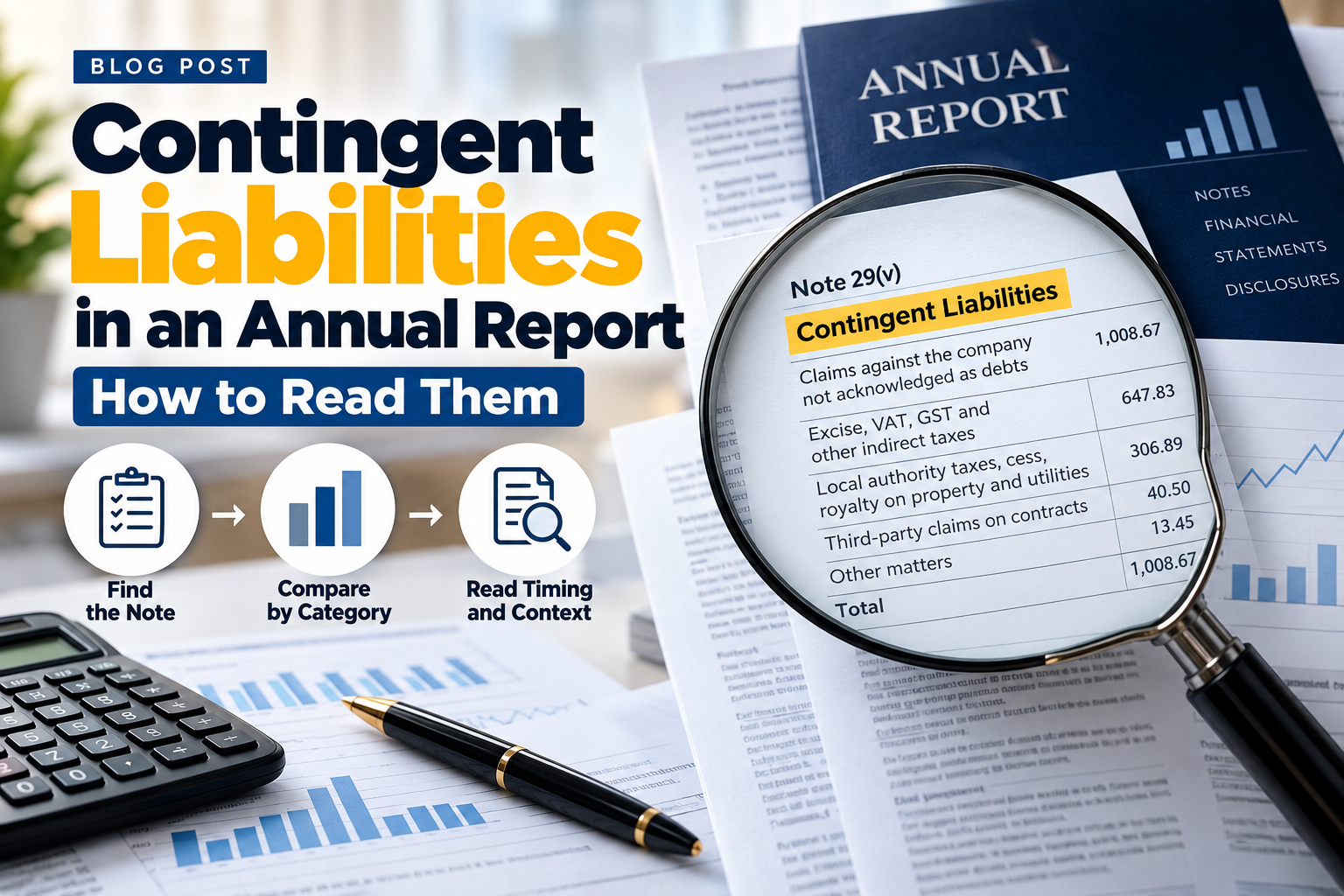
A contingent liability is a possible obligation that depends on an uncertain event, such as a tax demand the company is contesting. It is disclosed in the notes to the accounts, not charged against profit. To read one, find the note, split the total by category, compare each category with last year, and read what the company says about timing.
Where an amount sits matters. If it is a provision, it has already reduced the profit you see. If it is a contingent liability, it has not. That line is a judgement, and this year one auditor disagreed with where a company drew it.
Provision or contingent liability
The rules are in Ind AS 37, Provisions, Contingent Liabilities and Contingent Assets, the accounting standard notified by the Ministry of Corporate Affairs. It sorts a possible payment into one of three places.
| If | Treatment | Effect on profit |
|---|---|---|
| There is a present obligation, an outflow is probable, and the amount can be estimated reliably | Provision, recognised in the balance sheet | Already charged |
| The obligation is only possible, or an outflow is not probable, or it cannot be measured reliably | Contingent liability, disclosed in the notes | Not charged |
| The chance of an outflow is remote | Neither recognised nor disclosed | Not charged |
Source: Ind AS 37, paragraphs 14, 27 and 28.
So a disclosed contingent liability is not a bill, and it is not nothing either. It is the company telling you which arguments it is still having. The judgement can be contested: in MMTC’s results for 2025-26, the auditor qualified its opinion because ₹82.82 crore was shown as a contingent liability that, in the auditor’s view, should have been a provision. Had it been provided for, the auditor said, standalone profit of ₹212.07 crore would have been ₹129.25 crore. We walked through that case in what an auditor qualification means.
Where to find it
Under Schedule III of the Companies Act, contingent liabilities are classified as claims against the company not acknowledged as debts, guarantees, and other money for which the company is contingently liable. Those are the words to search for in an annual report. The note is usually near the end of the notes, often among the “additional notes”, and the accounting policies at the front say how the company decides what goes into it.
Read one more passage before the note. Many companies list claims and contingencies among their key sources of estimation uncertainty. ITC’s says that where an outflow is believed to be probable and can be estimated reliably, management provides for its best estimate, and that information about the litigation is in the notes. That sentence is the company describing where it draws the line in the table above.
If the annual report itself is new to you, start with our guide to reading an annual report without reading all of it.
A worked example: ITC’s note for 2025-26
ITC’s note sits at Note 29(v), on page 177 of its Report and Accounts 2026. It reports claims against the company not acknowledged as debts of ₹1,008.67 crore, against ₹917.25 crore a year earlier, in four categories.
| Category | 31 Mar 2026 | 31 Mar 2025 | Change |
|---|---|---|---|
| Excise, VAT, GST and other indirect taxes | ₹647.83 crore | ₹627.25 crore | +₹20.58 crore |
| Local authority taxes, cess, royalty on property and utilities | ₹306.89 crore | ₹237.21 crore | +₹69.68 crore |
| Third-party claims on contracts | ₹40.50 crore | ₹39.40 crore | +₹1.10 crore |
| Other matters | ₹13.45 crore | ₹13.39 crore | +₹0.06 crore |
| Total | ₹1,008.67 crore | ₹917.25 crore | +₹91.42 crore |
Source: ITC Limited, Report and Accounts 2026, standalone financial statements, Note 29(v)(a). ₹ crore. Change is our arithmetic.
You do not need last year’s annual report for the comparison. ITC’s note, like many, prints the previous year’s figure in brackets after each amount, so the change by category takes a minute to work out.
Read category by category, the note says something precise.
- Most of it is indirect tax. ₹647.83 crore, close to two-thirds, is excise, VAT, GST and similar claims that ITC says it disputes on issues of “applicability and classification”: whether a tax applies, and at what rate.
- The growth is somewhere else. The total rose by ₹91.42 crore, about a tenth. Local authority taxes, cess and royalty rose by ₹69.68 crore, about 29%, and account for three-quarters of the increase.
- Part of it is interest. ₹316.00 crore of the total is estimated interest on the claims. A dispute that runs for years grows even if nothing new is claimed.
- There is no guarantee in it. All four categories are claims against ITC itself.
Two things put the number in proportion. The whole total is about 5% of ITC’s standalone profit for the year, ₹20,286.42 crore. And ITC states that it is not practicable to estimate when these issues will close or the timing of any cash flows. That is a normal statement for long-running tax disputes, and it is the honest answer to the question a reader most wants answered.
The same note then lists commitments, including ₹1,480.38 crore of capital contracts not yet executed. Commitments are not contingent liabilities. They are contracts the company has signed and intends to pay for. Do not add the two together.
Disputes rarely begin in the annual report. Many listed companies disclose a new tax demand or a court order to the exchange when it arrives, months before it is counted in a note. BSE publishes the filing. StockTool.AI’s plain-English summary is live one minute later, with the original source available for verification. The rest of the modules are on the StockTool.AI features page.
Follow exchange filings in plain English
StockTool.AI surfaces exchange filings with a plain-English summary and keeps the original source available for verification. Explore the rest of the modules on the features page.
Five things to check in any contingent liabilities note
| Check | What to look for |
|---|---|
| 1. The split | Tax, legal claims, guarantees and other matters, never just the total |
| 2. The change by category | Which category moved, not only whether the total did |
| 3. The interest inside | How much of the total is interest accruing on old disputes |
| 4. The company’s words | What it says about the basis of each dispute and about timing |
| 5. What sits elsewhere | Provisions already charged to profit, and commitments, which are a different thing |
Source: Ind AS 37; Schedule III, Division II, Companies Act 2013.
Size alone settles very little. A large company will carry large disputes, and a smaller number can matter more to a smaller company. The comparison that tells you most is with the company’s own previous year and with its own profit.
What the note cannot tell you
A contingent liabilities note gives amounts and categories. It does not usually give the probability of each dispute, which is part of why the amounts are not charged to profit. ITC’s amounts are claims that the company disputes, with interest where applicable: what has been claimed, not what the company expects to pay.
Nor will the note say which dispute is close to an end. For that, three other places help. The auditor’s report, which flags a disagreement over where the line was drawn, as MMTC’s did. The exchange disclosures of tax orders and court rulings during the year. And next year’s note, which shows which categories shrank because something was settled and which kept growing.
Read across two or three years, the note becomes a record of how a company’s disputes are going. Read once, it is a single photograph.
The number in the notes
A contingent liability does not say a payment is coming. It says an argument is still open, how much is at stake, and whether that has grown. Read which arguments, and how fast they are growing, before you read the total.
Disclaimer
StockTool.AI is a research and information platform and is not a SEBI-registered investment adviser or research analyst. Its AI-generated insights are based on public filings, transcripts, annual reports and other publicly available information. Summaries may not be exhaustive or error-free, and the original source document should always be treated as authoritative. Nothing here is investment advice or a recommendation to buy, sell or hold any security. Any decision taken on the basis of this information is the reader’s own. Investments in securities are subject to market risks.