
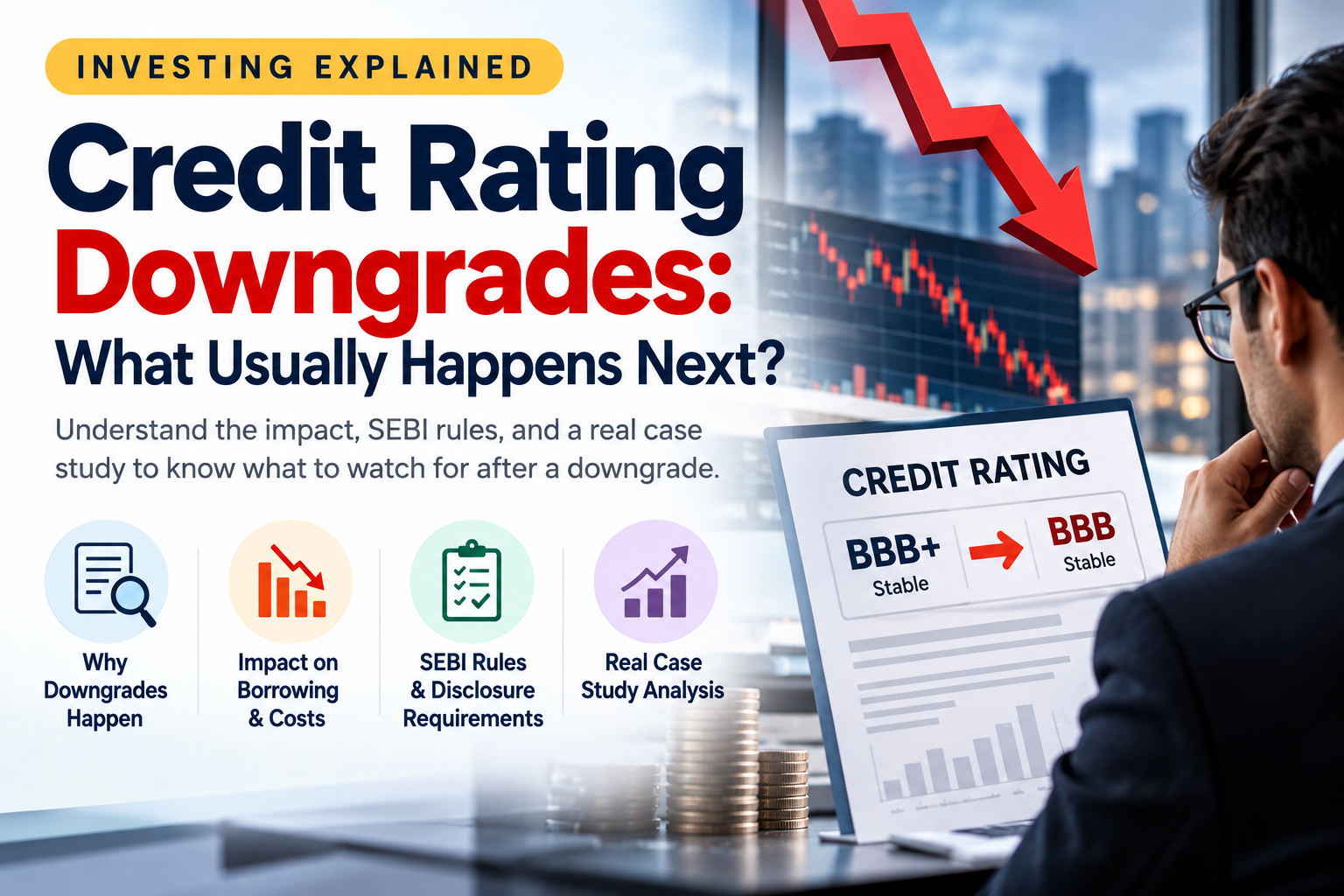
A credit rating downgrade means a rating agency now sees more risk that a borrower will not repay on time. It rarely means default is near: CRISIL says “In most cases” it does not. What follows depends on the agency’s stated reasons and the company’s next disclosures. Jai Balaji Industries’ September 2026 downgrade shows how to read both.
A rating agency is a company, registered with SEBI, that publishes its opinion on how likely a borrower is to repay. A rating covers specific loans or debt, called facilities, not the company as a whole. The rating rationale is the agency’s written explanation of why it chose a rating. Technical terms are explained where they first appear.
What a downgrade changes, and what it does not
CRISIL’s rating FAQs ask whether a downgrade means a default, a missed payment on a loan or bond, is imminent. They answer: “In most cases, a downgrade does not mean that a default is anticipated.” It means the risk on the debt is higher than before.
Two labels travel with a rating. An outlook is the agency’s view of where the rating is likely to move, which SEBI’s rules describe as the near to medium term; CRISIL puts it at one to two years. A rating watch is the same kind of view over the short term, used when a specific event needs assessing. CRISIL’s rating scale notes say neither is a promise: an outlook is “not necessarily a precursor of a rating change”, and a watch “does not imply that a rating will necessarily change”.
Where a downgrade is filed, and what the agency must show
A rating revision is an exchange filing. Under Regulation 30 of SEBI’s Listing Regulations (LODR), “New Rating(s) or Revision in Rating(s)” is listed in Schedule III, Part A, paragraph A, the events a company must disclose without testing whether they are material. Information that comes from outside the company must reach the exchanges within 24 hours under Regulation 30(6).
The agency’s press release must follow a standard format set by SEBI’s Master Circular for Credit Rating Agencies. Three required parts do most of the work for a reader. A Liquidity section, which rates the borrower’s ability to meet near-term payments as Superior or Strong, Adequate, Stretched or Poor. A Rating Sensitivities section, naming the performance levels that could move the rating up or down. And, for a review, the rating history for the past three years.
Source: SEBI LODR Regulations, last amended 14 July 2026, Regulation 30(6), page 58, and Schedule III Part A, item 3 of paragraph A, page 167; SEBI Master Circular SEBI/HO/DDHS/DDHS-POD3/P/CIR/2024/47 of 16 May 2024, paragraphs 10.1.3, 10.1.5, 10.1.6, 10.1.9, 10.2.2 and 10.3.
A real downgrade, read in five steps
On 21 September 2026 CRISIL Ratings downgraded Jai Balaji Industries Limited, which makes ductile iron pipes, steel products and ferro alloys and is listed on NSE and BSE. The company filed the rationale with the exchanges on 23 September under Regulation 30, and the filing is the source for everything below. The example uses the agency’s and the company’s own words and is not a view on the company.
Step 1: Record the exact rating action
| Item | What the filing says |
|---|---|
| Agency and date | CRISIL Ratings, 21 September 2026 |
| What was rated | Bank loan facilities of Rs 995 crore (one crore is 10 million), of which Rs 295 crore are “proposed” limits |
| Long-term rating | Crisil BBB / Stable, from Crisil BBB+ / Stable |
| Short-term rating | Crisil A3+, from Crisil A2 |
| Earlier long-term ratings | BBB- in early 2024, BBB on 30 September 2024, BBB+ on 25 October 2024, BBB+ again in July 2025 and January 2026 |
Source: Jai Balaji Industries Limited, filing of 23 September 2026 enclosing the CRISIL Ratings rationale of 21 September 2026, pages 2 and 5 of the filing.
The long-term rating covers Rs 770 crore of fund-based facilities, where the lender provides money. The short-term rating covers Rs 225 crore of non-fund-based limits, where the lender gives a guarantee or a letter of credit instead of cash. The action covers bank facilities only, from eight named lenders, and does not apply to anything else the company owes. The history is why the action reads as a return to BBB, the level CRISIL assigned in September 2024, after a period at BBB+.
A revision in rating is an exchange filing, so it also reaches users as an alert through StockTool.AI’s exchange filing AI summaries. BSE publishes the filing. StockTool.AI’s plain-English summary is live one minute later, with the original source available for verification. The Credit Rating Insights module sits under Core Insights; see it on the StockTool.AI features page.
Step 2: Separate what happened from what the agency thinks
Three kinds of statement sit in every rationale, and mixing them makes the analysis sound more certain than the evidence allows. Here is each, taken from this one.
| Kind | Example in the rationale |
|---|---|
| Reported fact | Revenue fell 8% to Rs 5,786 crore in fiscal 2026, the year to 31 March 2026. EBITDA margin (operating profit before interest, tax, depreciation and amortisation, as a share of revenue) fell to 6% from 14%. Capacity utilisation, the share of installed capacity in use, in the ductile iron pipe business fell to about 30% from 80%. |
| Agency’s assessment | The agency cites “weaker-than-expected operating performance” in fiscal 2026. Financial flexibility “remains constrained due to lack of access to working capital debt”. Working capital is the money tied up in buying inputs, making goods and collecting payment. |
| Conditional risk | The downward factors under Rating sensitivity factors, such as large debt-funded capital spending or a stretched working capital cycle. |
Source: CRISIL Ratings rationale of 21 September 2026, pages 2 and 3 of the filing. The explanations of EBITDA margin, capacity utilisation and working capital are ours.
The agency also gives the cause of the fall: slower government water projects, including the Jal Jeevan Mission and AMRUT, weakened demand for ductile iron pipes, and demand for TMT steel bars was subdued. It says return on capital employed, operating profit relative to the money invested in the business, fell to 8.8% from over 20% in each of the three earlier years.
Step 3: Compare the rationale with the company’s own filing
The company’s covering letter says “the financial health of the Company remains sound”, and that its “total outstanding debt is less than its revenue generated in a single month”. The rationale agrees on debt: it calls the capital structure “comfortable”, with gearing, debt relative to net worth, at 0.2 time on 31 March 2026. Its concerns lie elsewhere, in operating performance and in access to working capital debt.
Hold both. Leverage is low, and operating performance weakened. The two documents answer different questions, and neither settles what the next results will show.
Step 4: Read the liquidity and repayment lines
CRISIL rates the company’s liquidity Adequate, one of the four standard terms. Its reasons are specific. Bank limit utilisation averaged 71% over the 12 months to May 2026. Annual cash accrual, the cash the business generates itself, is expected above Rs 500 crore against yearly term debt repayments below Rs 200 crore. The current ratio, assets due within a year against liabilities due within a year, was 1.35 times. Free cash and bank balance was estimated above Rs 20 crore on 30 July 2026. These are the agency’s estimates, so check them against the next results.
The rationale also points to a “sizeable debt obligation in fiscal 2027”. The annexure lists each facility, its lender and each term loan’s final maturity date, the first on 31 October 2026 and the last on 30 June 2029. Watch for completed renewals or refinancing, which means taking a new loan to repay an old one. A proposed refinancing is not completed funding.
Step 5: Revisit the agency’s sensitivities
The Rating Sensitivities section is the agency’s own checklist. Here, one upward factor is “operating margin of over 9%”. Downward factors include “Large, debt-funded capex, stretch in the working capital cycle, sizeable dividend payout or investments in non-core assets”. The margin CRISIL reports for the June 2026 quarter is about 9%, and it says that sustaining the recovery and further improvement in profitability “remain monitorable”.
That places the company against the agency’s list. It is not a forecast. The next results and the next rating action will show whether the pressure has eased; compare them with this rationale and with the rating history, which any review must repeat.
Does a downgrade tell you what happens to the share price?
No. A rating is an assessment of credit risk, not a forecast of a share price. Investors may have expected the news, other events may land the same week, and different investors read the same evidence differently, so a downgrade can sit beside a fall, a small move or no move. Ask instead whether the filings show the change in fundamentals the agency describes, and whether later filings support or challenge it. Nothing in the Jai Balaji filing speaks to its share price, and this post does not.
The next disclosure matters more than the headline
A downgrade records a change in how an agency sees repayment risk. Keep the rationale, read the company’s own filing next to it, and return to the agency’s sensitivities when the next results arrive. That leaves a record of what changed and when, without mistaking a risk signal for a certain outcome.
Disclaimer
StockTool.AI is a research and information platform and is not a SEBI-registered investment adviser or research analyst. Its AI-generated insights are based on public filings, transcripts, annual reports and other publicly available information. Summaries may not be exhaustive or error-free, and the original source document should always be treated as authoritative. Nothing here is investment advice or a recommendation to buy, sell or hold any security. Any decision taken on the basis of this information is the reader’s own. Investments in securities are subject to market risks.