
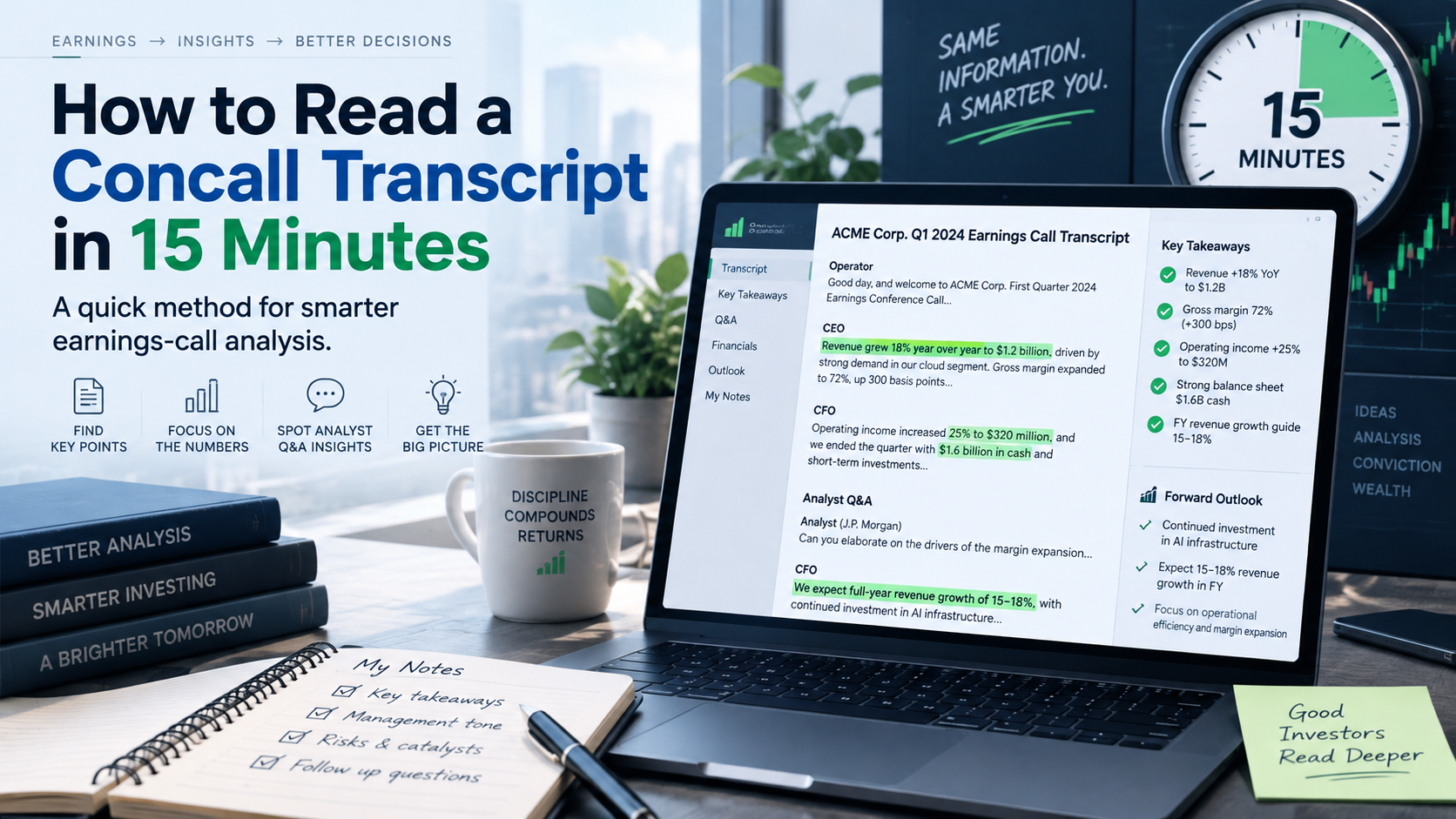
Read a concall transcript in five short passes rather than front to back. Three minutes on the numbers, three on the reason behind them, four on the analyst questions, three on what management expects next, and two to write five lines. You will finish with more than most people get from an hour.
That is the whole method. The rest of this post explains each pass, then walks through a real transcript so you can see it work.
Why front to back is the wrong way in
A transcript is not written like an article. It has no inverted pyramid and no summary at the top. The useful material is spread across the management commentary and the question-and-answer section, and some of the most valuable details appear only when an analyst pushes management on a number they would rather move past.
So the mistake is not reading slowly. It is reading in the order the document happens to be printed in.
Minutes 0 to 3: what happened
Start with the management commentary and pull out only the numbers that describe the quarter.
- Revenue or income, and which way it moved
- Profit, and which way it moved
- Margins
- Volumes, where the business has them
- Anything unusually large, or described as one-off
Do not try to capture everything. At this stage you are establishing what happened, not why. If management says profit rose sharply, write the figure down and keep moving. The next three minutes are for the explanation.
Minutes 3 to 6: why it happened
Now search the text for the joining words: because, due to, driven by, impacted by, higher, lower, benefit, pressure.
A profit figure on its own tells you very little. The explanation tells you whether the change came from stronger volumes, better margins, lower costs, a helpful commodity price, a one-time item, or something in the business that has genuinely improved.
That distinction is the whole reason to read a transcript rather than a headline. A good quarter caused by something temporary and a good quarter caused by the business working better look identical in the results table and completely different here.
Minutes 6 to 10: what the analysts asked
This is the section first-time readers skip, and it is usually the richest.
Find the question-and-answer section and read the questions first, before any of the answers. In two minutes you will see which areas professional investors thought needed clarifying, which is a free map of where the doubts are.
Pay particular attention when several analysts return to the same subject. If three separate people ask about margins, or demand, or a delayed project, that topic matters more than a long prepared paragraph about routine operations.
Then read the answers, listening for the difference between these:
| What management says | What it actually means |
|---|---|
| “We expect” | An outlook. A stated expectation, not a result. |
| “We are evaluating” | Nothing has been decided yet. |
| “We remain confident” | A view held by management. Not evidence. |
| “We cannot comment” | Often the most informative answer in the call, particularly where the question concerns a pending decision. |
You do not need to interpret every sentence. You are looking for the boundary between what management is willing to say clearly and what it is not.
Minutes 10 to 13: what comes next
Spend three minutes on the forward-looking parts. Guidance on volumes, margins, capital expenditure, new projects, capacity, demand, expansion, timelines.
Keep what has already happened separate from what management expects to happen. That one habit prevents the commonest reading error there is, which is treating an expectation as a confirmed result.
While you are here, note anything that could make the next quarter look unlike this one. A commodity price, a project coming online, a regulatory decision, a change in demand. Any of those is usually more important than another page of historical commentary.
Minutes 13 to 15: write five lines
Before you close the document, answer five questions in one line each.
- What happened this quarter?
- What was the main reason?
- What did analysts push on?
- What does management expect next?
- What is the main uncertainty to watch?
If you can answer all five, you have most of what the transcript had to offer. If one answer is unclear, that tells you exactly which section to reopen, rather than starting again from page one.
The method on a real transcript
GAIL (India) Limited held its Q1 FY27 earnings call on 31 July 2026 and published the transcript on 4 August 2026. Here is what the five passes would have found.
Pass one, what happened
Standalone gross turnover of about ₹38,912 crore, up roughly 12% on the previous quarter. Standalone profit after tax of about ₹4,292 crore, against ₹1,262 crore in the quarter before. Gas transmission volumes of 122 MMSCMD, which is the unit the gas industry uses for daily pipeline throughput, million metric standard cubic metres per day.
Your note: profit more than tripled quarter on quarter. Find out why.
Pass two, why it happened
The explanation was a favourable pricing position in the gas marketing business, which is the difference between the price at which the company buys gas and the price at which it sells it. When those two are linked to different benchmarks that move apart, a gap opens that has nothing to do with selling more gas.
Your note, rewritten: profit rose on a pricing gap, not on volumes. Check whether management expects it to last.
Pass three and four, the questions and the forward view
This is where the transcript pays for the fifteen minutes. Management did not leave the question hanging. The Director of Finance described the advantage as expected to be largely short-term, and kept the full-year gas marketing profit guidance at around ₹4,500 crore, which is well below what a straight annualisation of the quarter would give you.
Read those two things together and management has told you, in its own words, not to extrapolate the quarter. Full-year capital expenditure guidance stayed at about ₹11,500 crore, of which ₹6,176 crore was already spent in the first quarter, and transmission volumes were expected at around 123 MMSCMD for the year against 122 delivered in the quarter.
Pass five, the five lines
| What happened | Profit more than tripled quarter on quarter |
|---|---|
| Why | A favourable pricing gap in gas marketing, not higher volumes |
| What analysts pushed on | Gas marketing, sourcing, transmission volumes, projects |
| What management expects | The pricing advantage to be largely short-term; full-year gas marketing profit around ₹4,500 crore |
| What to watch | Whether the pricing gap persists, and whether transmission volumes move beyond 123 MMSCMD |
Source: GAIL (India) Limited Q1 FY27 earnings conference call, held 31 July 2026. Transcript, published 4 August 2026 and notified to BSE and NSE under reference ND/GAIL/SECTT/2026. All figures are as stated by the company.
Notice what the method did here. The headline number was spectacular and the transcript contained an explicit instruction from management not to read too much into it. A reader who stopped at the profit figure would have drawn the opposite conclusion from a reader who spent three more minutes.
This is the same pattern we wrote about in why a stock can fall on good results, where the reported numbers were fine and the call was not. The numbers are already public when the call begins. What moves the reading is what management says about what comes next.
Where the fifteen minutes goes
If you read earnings calls regularly, the passes above are the part worth keeping and the switching between a thirty-page document and your notes is the part worth removing. Concall Takeaways in StockTool.AI gives you the main points of any listed Indian company’s call in plain English, about a minute after the transcript is out, so the fifteen minutes goes into checking the parts that matter to you rather than into finding them. The transcript stays the reference point. Anything you intend to rely on, read in the original.
What you can leave until later
A fifteen-minute read is not about ignoring information. It is about deciding what earns your attention first. These can usually wait:
- Greetings and introductions
- Descriptions of the business you already know
- Prepared commentary that repeats the results presentation
- Long explanations of things already in the filing
- Questions answered earlier in the same call
One exception. If any of those contains a number, an explanation or a change that bears on the quarter, stop and read it properly.
When fifteen minutes is not enough
Go further when the company has reported a major change in its business, when management has introduced a new project or strategy, when several analysts are pressing the same issue, when guidance has moved materially, when there is a large one-time gain or expense, or when you are researching the company properly rather than doing a routine quarterly check.
The method is a starting point, not a replacement for the document. For a routine quarter, five good notes may be all you need. For something that has genuinely changed, they are how you know where the next thirty minutes should go.
A worksheet for your next transcript
| Quarter | What changed? |
|---|---|
| Reason | Why did it change? |
| Questions | What did analysts ask management to clarify? |
| Guidance | What numbers or targets did management give for the coming periods? |
| Projects | What new spending, capacity or expansion was discussed? |
| Watch | What could make the next quarter look different? |
Fill it in as you read. At the end of fifteen minutes you have a short record that is far easier to come back to than thirty pages.
The short version
Stop treating a transcript as a document to be finished. Start with the numbers. Find the reason behind them. Read the analyst questions before the answers. Note what management expects rather than what it has delivered. Then write down the one or two uncertainties worth another look.
Fifteen minutes spent that way tells you what happened, why, what is expected next and what to watch. Fifteen minutes spent reading from page one tells you what is on the first four pages.
Disclaimer
StockTool.AI is a research and information platform and is not a SEBI-registered investment adviser or research analyst. Its AI-generated insights are based on public filings, transcripts, annual reports and other publicly available information.
Summaries may not be exhaustive or error-free. The original source document always governs. Users should verify important information against primary sources before making decisions.
Investment decisions are solely the user’s responsibility and are subject to market risks.