
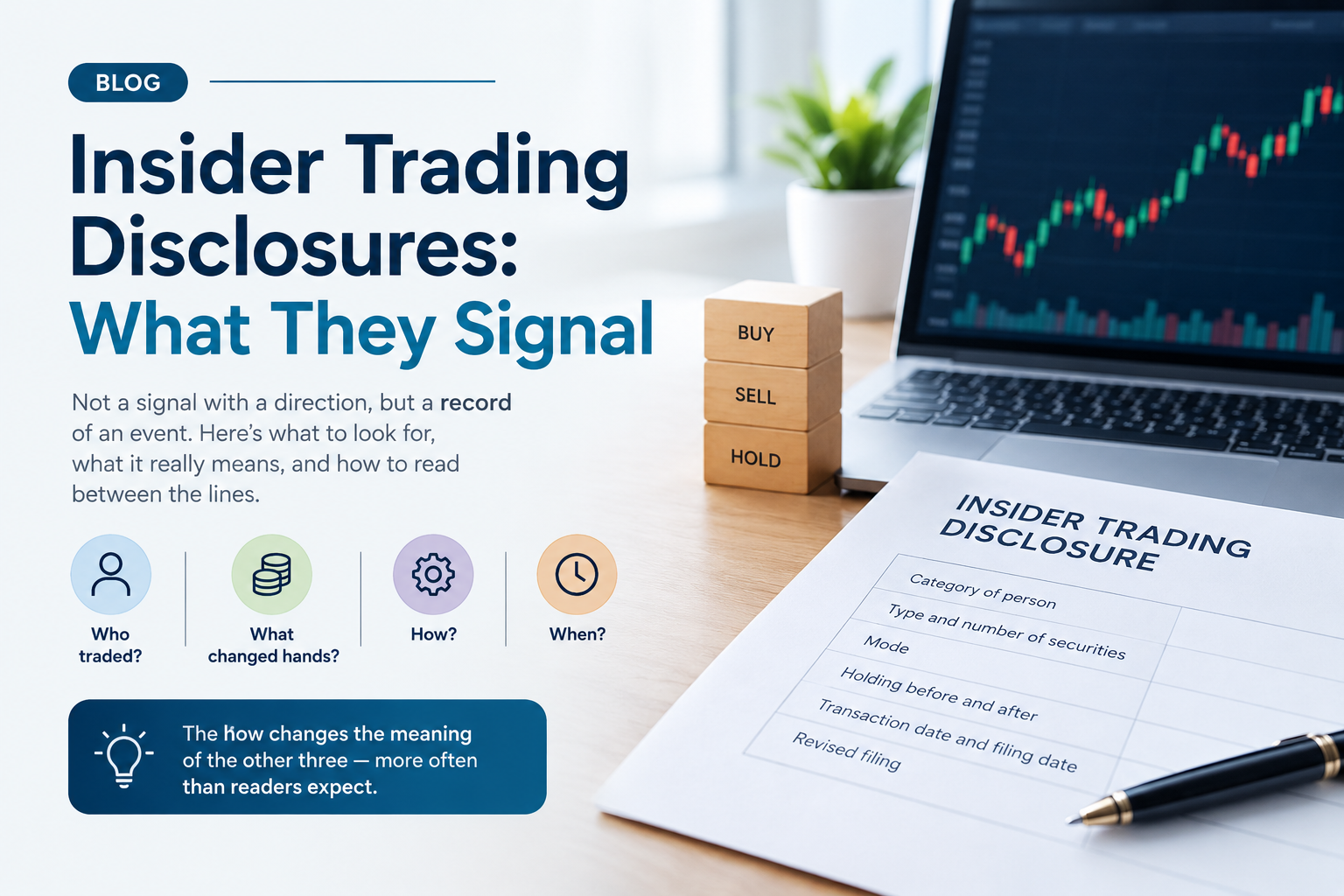
An insider trading disclosure shows who traded, what changed hands, how, and when. Those four facts are useful, and one of them, how, changes the meaning of the other three more often than readers expect. What the disclosure never tells you is why. Read it as a record of an event and a starting point, not as a signal with a direction.
First, what the phrase means
The name is unfortunate. An insider trading disclosure is not a report of wrongdoing. It is a routine filing that records a lawful trade by someone close to a listed company: a promoter, a director, a senior employee or one of their immediate relatives.
On the exchange it appears under the heading Regulation 7(2), which is worth recognising because it is printed on the filing itself. The offence people usually mean by insider trading, dealing on information the market does not have, is a different matter entirely, and these filings exist partly to keep the two apart.
When a disclosure appears
Not every trade produces one. The rule is triggered when a person’s trades in the company’s securities add up to more than ₹10 lakh in value within a calendar quarter. One trade can cross that line, or several small ones together.
Once it is crossed, the person tells the company within two trading days, and the company tells the exchange within two more. So a disclosure can reach you up to four trading days after the trade.
On BSE these filings sit in their own category, Insider Trading / SAST, one of the nine we went through in every BSE filing type explained in one line.
You do not have to watch the category yourself. BSE publishes the filing. StockTool.AI’s plain-English summary is live one minute later, with the original source available for verification. The rest of the modules are on the StockTool.AI features page.
Six fields, and the question each one answers
| Field on the filing | What to ask |
|---|---|
| Category of person | Promoter, director, employee or relative? They stand in different places |
| Type and number of securities | Exactly what was acquired or disposed of, and how much? |
| Mode | Market trade, off-market transfer, gift, employee share plan? This is the field most often skipped and the one that most often changes the reading |
| Holding before and after | How much did the person’s position actually change? |
| Transaction date and filing date | When did it happen, and when did the market find out? |
| Revised filing: yes or no | Is this the first version, or a correction of an earlier one? |
Read together, the six answer one question: what changed? None of them answers the harder one, which is why.
One note on dates. People inside a company can only trade when the trading window is open, which is why these disclosures cluster in the weeks after results. We covered that in what a trading window closure actually tells you.
A real filing shows why the mode matters
On 10 June 2026, Siyaram Silk Mills filed a disclosure covering six people, all of them promoters of the company and three of them also directors. Every transaction took place on 8 June.
Start with the last line of it, because that is the one a quick reader would stop at.
| Person | Transaction | Shares | Holding before | Holding after |
|---|---|---|---|---|
| Promoter and director | Disposal | 10,28,500 | 2.27% | 0.00% |
| Promoter and director | Acquisition | 2,31,168 | 4.68% | 5.19% |
| Promoter | Acquisition | 2,28,083 | 3.84% | 4.34% |
| Promoter and director | Acquisition | 1,70,583 | 4.61% | 4.99% |
| Promoter | Acquisition | 2,28,083 | 3.84% | 4.34% |
| Promoter | Acquisition | 1,70,583 | 4.61% | 4.99% |
Source: Siyaram Silk Mills Limited, disclosure under Regulation 7(2), filed 10 June 2026.
Read only the first row and you have a promoter and director whose holding went from 2.27% to almost nothing in a single day. That is the sentence that travels.
Now read two more fields. The mode, for all six rows, is Gift. The value, for all six rows, is zero.
Then add up the five acquisitions. They come to 10,28,500 shares, which is exactly the number disposed of in the first row. One promoter gave. Five promoters received. Nothing was sold, nothing was bought, and no money changed hands.
So the shares did not leave the promoters. They moved between them. One person’s line changed a great deal and the group’s combined position, on these six rows, did not change at all.
The filing gives no reason for the gift, and we are not offering one. The notes column says NA. What the filing does give you is enough to stop the wrong sentence being written.
If you want to confirm the group position for yourself, the place to look is the quarterly shareholding pattern, and the method is in our five-minute promoter shareholding check.
One transaction is rarely the whole story
Once you can read a single disclosure, look at what came before and after it.
A person who sells a small part of a large holding once has told you very little. Several disclosures over some months, each showing a sale and a lower holding, are a different set of facts. The same is true in the other direction: one acquisition through an employee share plan is not the same thing as a run of purchases in the market.
Neither pattern is a forecast. The point of lining disclosures up is to describe the change in ownership accurately, and to notice when a filing has been revised, because a correction can change a field without changing the trade.
Size needs context too
The value column can mislead in both directions. In the Siyaram filing it reads zero against more than ten lakh shares, because a gift has no price. In another filing a value of several lakh rupees may be a rounding error against what the person still holds.
So the useful question is never how large the trade was. It is how much the trade changed the person’s position, and the before and after columns answer that directly.
What the disclosure cannot tell you
It cannot tell you why someone bought, sold, gave or received. It cannot tell you whether a sale followed a personal need, a tax plan, a family arrangement or anything else, unless the filing says so, and it almost never does. It cannot tell you what the share price will do.
That is why “insider selling is a warning sign” and “insider buying shows confidence” are both too broad to apply to a single filing. The document gives you an observable event. The interpretation needs more than the document.
The goal is not to decide whether a transaction is good or bad. It is to establish exactly what happened, know what the filing can support, and know what it cannot.
Disclaimer
StockTool.AI is a research and information platform and is not a SEBI-registered investment adviser or research analyst. Its AI-generated insights are based on public filings, transcripts, annual reports and other publicly available information. Summaries may not be exhaustive or error-free, and the original source document should always be treated as authoritative. Nothing here is investment advice or a recommendation to buy, sell or hold any security. Any decision taken on the basis of this information is the reader’s own. Investments in securities are subject to market risks.