
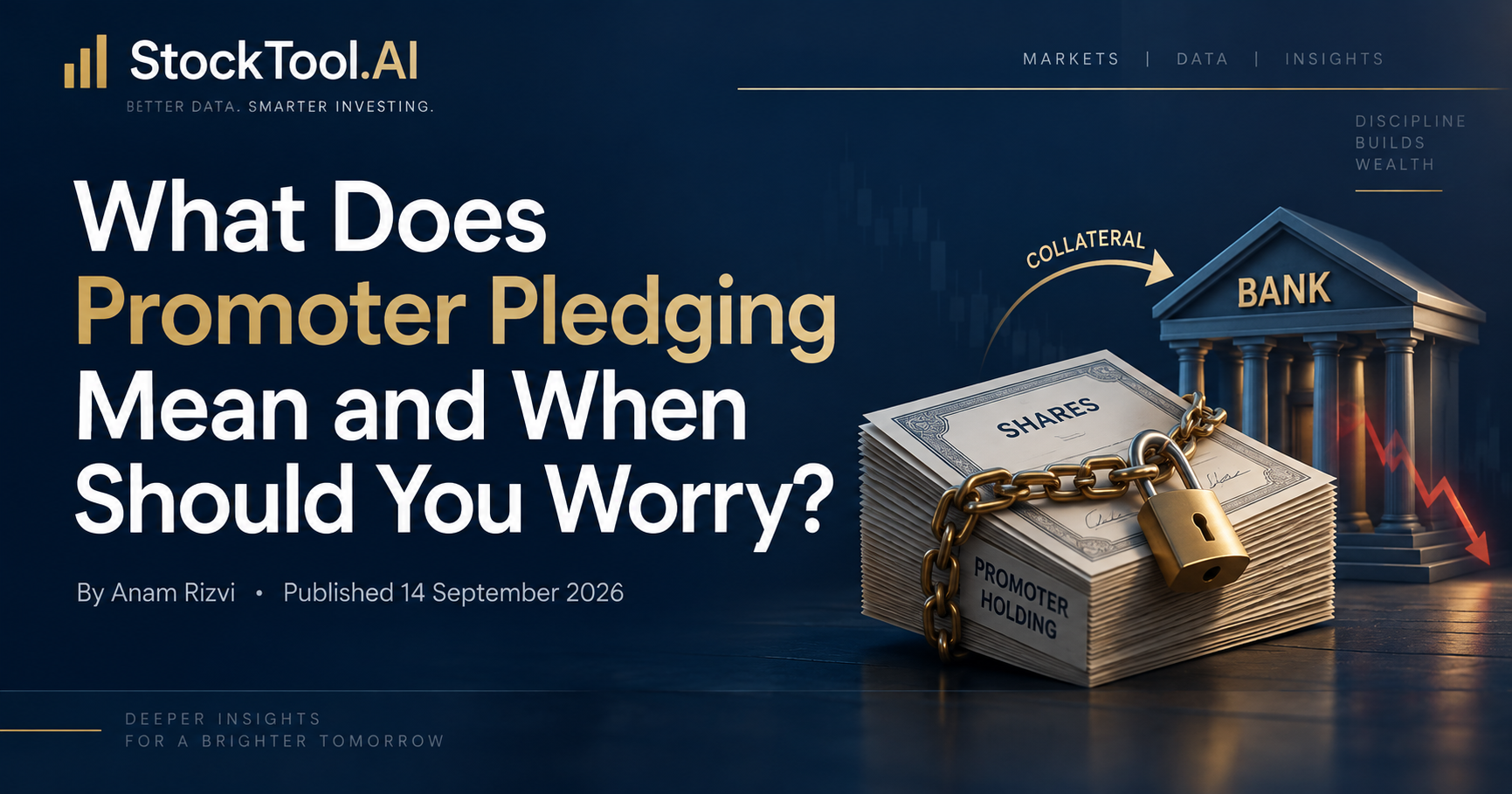
Promoter pledging means the people who own and run a company have taken a loan and put up their own shares as security, the way someone might take a loan against gold. It is common, and often harmless. It is worth worrying about when the pledged amount keeps growing, the share price is falling, and the company is already under strain.
First, who is a promoter
A promoter is the person, family or group that founded the company and still controls it. In most Indian listed companies the promoters own a large chunk of the shares. When you read that promoter holding is 45 per cent, it means they own 45 out of every 100 shares in the company.
What pledging actually is
Think of a gold loan. You own gold. You need money. You hand the gold to a lender, the lender gives you cash, and you get the gold back when you repay. You still own it the whole time. But if you do not repay, the lender can sell it.
Promoter pledging is the same arrangement with shares instead of gold.
A promoter needs money, sometimes for the company and sometimes for something else. Rather than sell shares, they hand some of them to a lender as security and borrow against them. They still own those shares and still vote with them. But if they cannot repay, the lender can sell them.
In company documents you will sometimes see the word "encumbered" instead of "pledged". It covers pledging and a few similar arrangements. If you are searching a filing, search for both words.
Why it is not automatically a bad sign
Pledging is borrowing, not selling. A promoter who pledges shares has not walked away from the company. The money might be funding a new factory, covering a short-term need, or simply costing less than borrowing another way.
Plenty of large, healthy Indian companies have had pledged promoter shares at some point. On its own, the word "pledged" tells you very little.
Why it can still go wrong
This is the part worth reading twice.
A lender does not hand over the full value of the shares. Roughly speaking, they lend about half. That gap is their cushion in case the share price falls. If the price does fall, the cushion shrinks, and the lender asks the promoter to make up the difference with more cash or more shares, usually within about a week. Those are the Reserve Bank’s rules for this kind of lending.
If the promoter can top it up, nothing happens and you never hear about it.
If the promoter cannot, the lender is entitled to sell the shares it is holding. In filings this is called invocation. Those shares go into the open market, the price tends to fall further, and the promoter ends up owning less of their own company.
That is the whole chain. Price falls, lender asks for more cover, promoter cannot provide it, lender sells, price falls further.
Where you actually find the number
You do not need a subscription or a terminal for this.
Every listed company in India files a document called the shareholding pattern once every three months. It lists who owns the company. Next to the promoters there is a column for shares that are pledged or encumbered. That is the number. It is free, it is on the exchange website, and it is usually on the company’s own investor page.
One catch. It comes out four times a year, so it can be up to three months out of date.
There is a faster filing as well. When a promoter pledges shares, gets them back, or has them sold by the lender, they have to tell the exchange within seven working days. Those notices appear in between the quarterly documents, so if something is moving, that is where you see it first. The exchange publishes them here.
And the rules give you one more thing. If promoters have pledged more than half of their own shares, or more than a fifth of the whole company, they have to state the reasons. That has been the position since October 2019. So past that point, why they borrowed is not a mystery. It is a filing you can read, and if it is vague or missing, that itself is worth noticing.
Six things that turn a pledge into a question
None of these is a verdict on its own. Together they are the checklist.
1. A lot of it. There is no official safe level. Many investors start paying attention somewhere around a fifth to a quarter of the promoter’s shares. The rules treat half as the point where an explanation becomes compulsory.
2. A falling share price. This is the one that turns a slow problem into a fast one, for the reason above. A large pledge on a rising stock is a very different situation from the same pledge on a falling one.
3. The money did not go to the company. A promoter can borrow against company shares and spend it on something unrelated. The company carries the risk without getting the cash. Past the disclosure threshold you can read what they said it was for.
4. The company is already carrying debt. A stretched promoter sitting on top of a stretched company means two sets of borrowings under pressure at the same time. Check whether the company’s cash from its operations is weak or falling while the pledge is rising.
5. The pledge is rising while the promoter’s stake is shrinking. They own less of the company and have borrowed against more of what is left.
6. Almost no large investors on the shareholder list. Mutual funds and foreign investors ask questions, and they can buy a large parcel of shares if one has to be sold quickly. A company owned almost entirely by small investors has neither.
Two real examples
These are real companies and real filings. Neither is a judgment on the company. They are here because the same headline event meant two opposite things.
Zee Entertainment, 2019
On 25 January 2019 the share price fell 31 per cent in a single day, to ₹299.70. Dish TV, another company owned by the same promoters, fell 37 per cent. At that point the promoters had borrowed about ₹13,500 crore against their shares, as Business Standard reported that day.
Two days later their lenders agreed not to treat the price fall as a default, on condition that the promoters found a buyer for part of the business within a set time. The share price rose 16.64 per cent the following Monday, which Business Standard also reported. The lenders did not have to agree. They chose to. Without that, the chain above would have run.
Now look at what the filings showed over the rest of that year. In the June quarter the promoters held 35.79 per cent of the company, and about 64 per cent of that was pledged. By early October they held about 22 per cent, and more than 90 per cent of it was pledged, reported on 5 October 2019.
Here is the trap a newcomer would fall into. Their borrowing had roughly halved over those months, from ₹13,500 crore to about ₹7,000 crore. Their shareholding had come down too. Read alone, both of those sound like things getting better. And the pledged share still went from 64 per cent to over 90 per cent, because they had sold so many shares that what remained pledged was now a much bigger slice of a much smaller holding.
One last detail, which is warning sign six in reverse. They were able to sell an 11 per cent stake because a large investor, Invesco Oppenheimer, was willing to buy it. A company owned mostly by small investors would not have had that option.
Apollo Hospitals, 2025
On 21 August 2025 the promoter group sold 1,897,239 shares, 1.3 per cent of the company, at ₹7,850 each. Their holding went from 29.3 per cent to about 28 per cent. The pledged portion of their holding fell from 13.1 per cent to about 2 per cent, and the company said the money was going to repay debt, per Business Today.
Same headline as Zee. Promoters sold, holding went down. Completely different meaning.
A five-minute check
1. Open the company’s latest shareholding pattern.
2. Find the promoter row and the pledged column. Write the number down.
3. Do the same for the previous three quarters. Is it going up, down or flat?
4. Check the promoters’ total holding over those same quarters. Which way is that going?
5. If more than half of their shares are pledged, find the filing that gives the reasons.
6. Glance at the share price over the same period, and at whether the company’s cash from operations is growing.
If the pledge is small, steady or falling and the company is doing fine, you can move on. If it is rising while everything else is getting worse, that is your signal to slow down and read further.
Doing this by hand means opening four separate filings. StockTool.AI’s Shareholding Changes module puts the promoters’ holding and the pledged portion next to each other across quarters, so you can see the direction on one screen and go to the actual filing for anything that looks odd.
The takeaway
Pledged shares are not a scandal. They are a loan, and loans are normal.
What you are watching for is a pledge that keeps growing while the share price falls and the company weakens. That combination is what has cost investors money in the past, and it is visible in free public documents months before it reaches the news.
One number tells you almost nothing. The direction of that number, read next to two or three others, tells you a lot.
Disclaimer
StockTool.AI is a research and information platform. It is not a SEBI-registered investment adviser or research analyst, and nothing here constitutes investment advice or a recommendation to buy, sell or hold any security.
All insights are AI-generated from publicly available filings, transcripts, annual reports and news. They are summaries, not complete records. THEY ARE NOT EXHAUSTIVE — a summary necessarily leaves material out, and the source document always governs. Information may contain errors or omissions, and data may be delayed or incomplete.
ANY INVESTMENT DECISION YOU MAKE IS ENTIRELY YOUR OWN. You are responsible for validating every piece of information you rely on against primary sources before acting on it. We accept no liability for any decision taken, or loss incurred, on the basis of anything published here.
Investments in securities markets are subject to market risks. Read all related documents carefully before investing.