
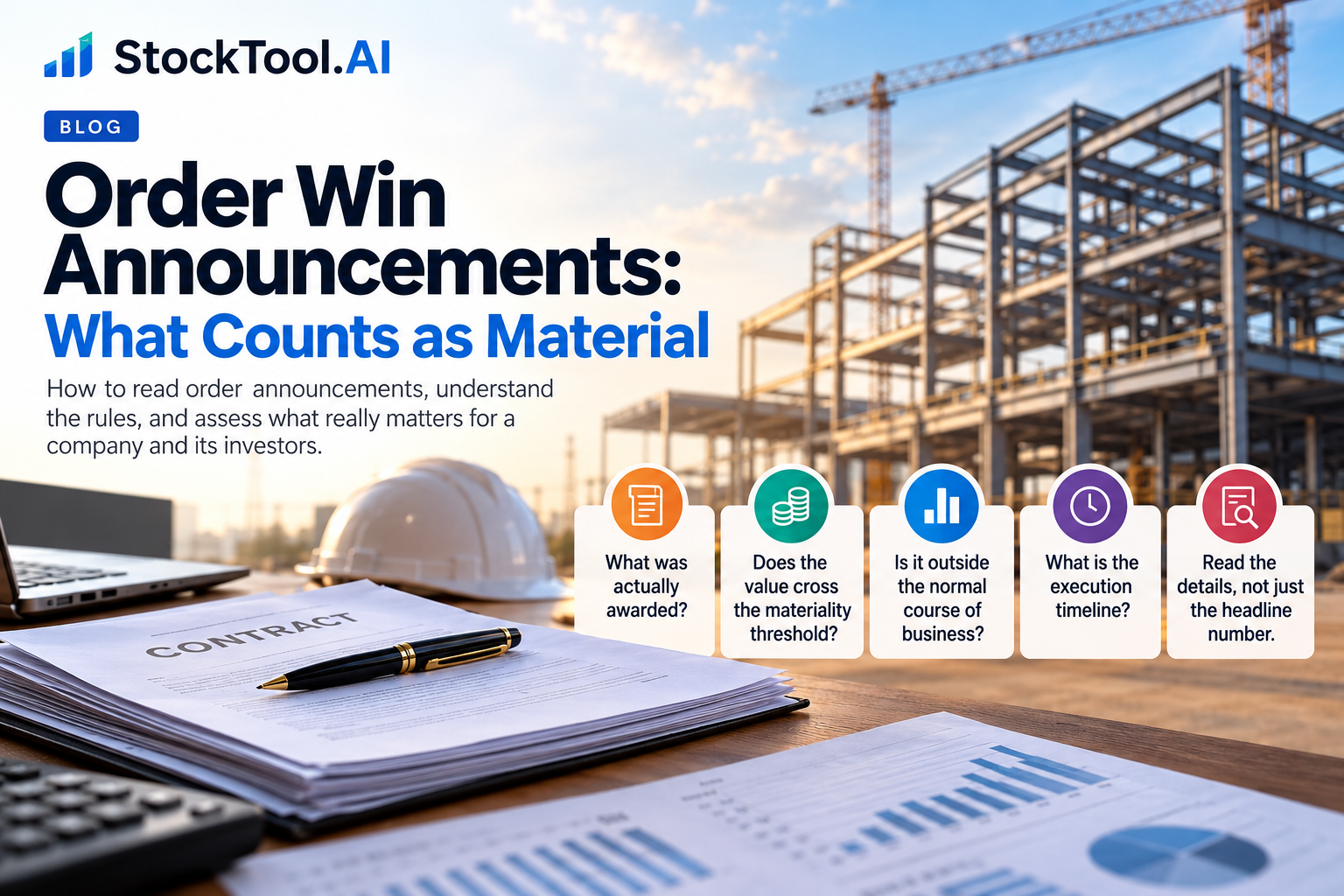
An order win is material when it could change something meaningful about a company: its revenue, its business, or what the market knows about it. The listing rules turn that into two questions. Is the order outside the company’s normal course of business? And does its value cross a line set by the company’s own size? Neither question is answered by the headline number on its own.
Order announcements are among the most common filings in the feed, and among the easiest to over-read. Here is how to read one properly.
First, read what was actually awarded
“Order win” covers a lot of ground. The filing may describe a firm purchase order, a letter of intent, a conditional contract, a framework agreement or a repeat order. The value may cover work spread over months or years.
So before the number, find the details behind it:
- Who awarded it, and is the customer named?
- What is being supplied or built?
- Is the value inclusive of taxes?
- How long will the work take?
- Are there conditions attached?
- Is this the kind of work the company normally does, or something new?
Those details often tell you more than the figure in the filing’s title.
What the rule actually says
Order announcements are made under Regulation 30 of the listing rules, the same regulation behind board meeting outcomes, and the name appears on many of these filings. Two parts of it matter here.
The first is scope. Orders and contracts fall under the materiality test when they are not in the normal course of business. An order for exactly the kind of work a company does every month is a different thing, under the rules, from one that takes it somewhere new.
The second is the test itself. An event is material if leaving it out would change the picture the public already has, or if disclosing it later would be likely to move the market significantly. There is also a value test. An event is material if its value, or its expected impact in value, exceeds the lowest of three figures:
- 2% of turnover
- 2% of net worth, unless net worth is negative
- 5% of the average absolute profit or loss after tax over the last three years
All three come from the latest audited consolidated accounts. The line is whichever of the three is lowest, so a company with modest profits can have a line well below 2% of its turnover. On top of this, every listed company has a board-approved materiality policy, which you will find on its website.
One consequence is worth knowing. Companies announce orders for more than one reason, so the existence of a filing is not proof that an order was material. You can see where these announcements sit in the feed in every BSE filing type explained in one line, and the disclosure clock that applies to them in how to read a board meeting outcome.
A real filing: a ₹61 crore order
On 6 October 2026, Interarch Building Solutions disclosed an order worth about ₹61 crore including taxes, for the design, engineering, manufacture and supply of a pre-engineered steel building for a copper refinery in Gujarat. The filing gave an execution period of about 12 months and did not name the customer, citing confidentiality.
Interarch’s revenue from operations for the year to March 2026 was ₹1,898 crore. So the order is about 3.2% of a year’s revenue.
Now apply the value test. On turnover alone, 2% of ₹1,898 crore is about ₹38 crore, and the lowest-of-three rule can only bring that line down, never up. So by value, this order clears it with room to spare.
That settles half the question. The other half is scope: whether an order like this is outside Interarch’s normal course of business. Pre-engineered buildings are what the company makes, so that is the part to read the filing and the company’s materiality policy for, rather than assume.
And one more thing the number does not tell you. With about 12 months of execution, the ₹61 crore will reach the revenue line over the year ahead, not in a single quarter.
Order announcements arrive throughout the trading day. BSE publishes the filing. StockTool.AI’s plain-English summary is live one minute later, with the original source available for verification. The rest of the modules are on the StockTool.AI features page.
Do not stop at the value
An order can matter for reasons that have little to do with its size. Look for:
- A new business line, sector or product the company has not served before
- A new geography
- A customer whose name matters more than the first contract’s value
- Capacity it will need: new plant, people or working capital
- Repeat potential, where a framework agreement may lead to more
Two orders of similar value can deserve very different levels of attention for exactly these reasons.
Contract value is not this year’s revenue
The announced value is a total, and it is usually stated including taxes. Check the execution period first, then look for milestones, payment terms, cancellation conditions and any quantities that are not yet firm. How and when the value becomes revenue depends on the contract and the accounting that applies to it, and the results that follow will show it.
Compare it with what the company normally wins
Context comes from the company’s own history. Look at its recent order announcements and its stated order book. Is this a routine size, or unusually large? A familiar customer, or a new one?
The useful question is never “is this a big order?” It is “is this a big order for this company, given what it normally does?”
The check, in one view
| Question | Where to look |
|---|---|
| What exactly was awarded, and to whom? | The order filing itself |
| Is it outside the normal course of business? | The filing, and the company’s materiality policy |
| Does it cross the value line? | The latest audited accounts: 2% of turnover, 2% of net worth, 5% of three-year average profit, whichever is lowest |
| When does the work happen? | The execution period in the filing |
| Is it unusual for this company? | Past order announcements and the stated order book |
There is no single rupee figure that makes an order material for every listed company. The rule sets the line by each company’s own size, and the reader’s job is to do the same.
Disclaimer
StockTool.AI is a research and information platform and is not a SEBI-registered investment adviser or research analyst. Its AI-generated insights are based on public filings, transcripts, annual reports and other publicly available information. Summaries may not be exhaustive or error-free, and the original source document should always be treated as authoritative. Nothing here is investment advice or a recommendation to buy, sell or hold any security. Any decision taken on the basis of this information is the reader’s own. Investments in securities are subject to market risks.