
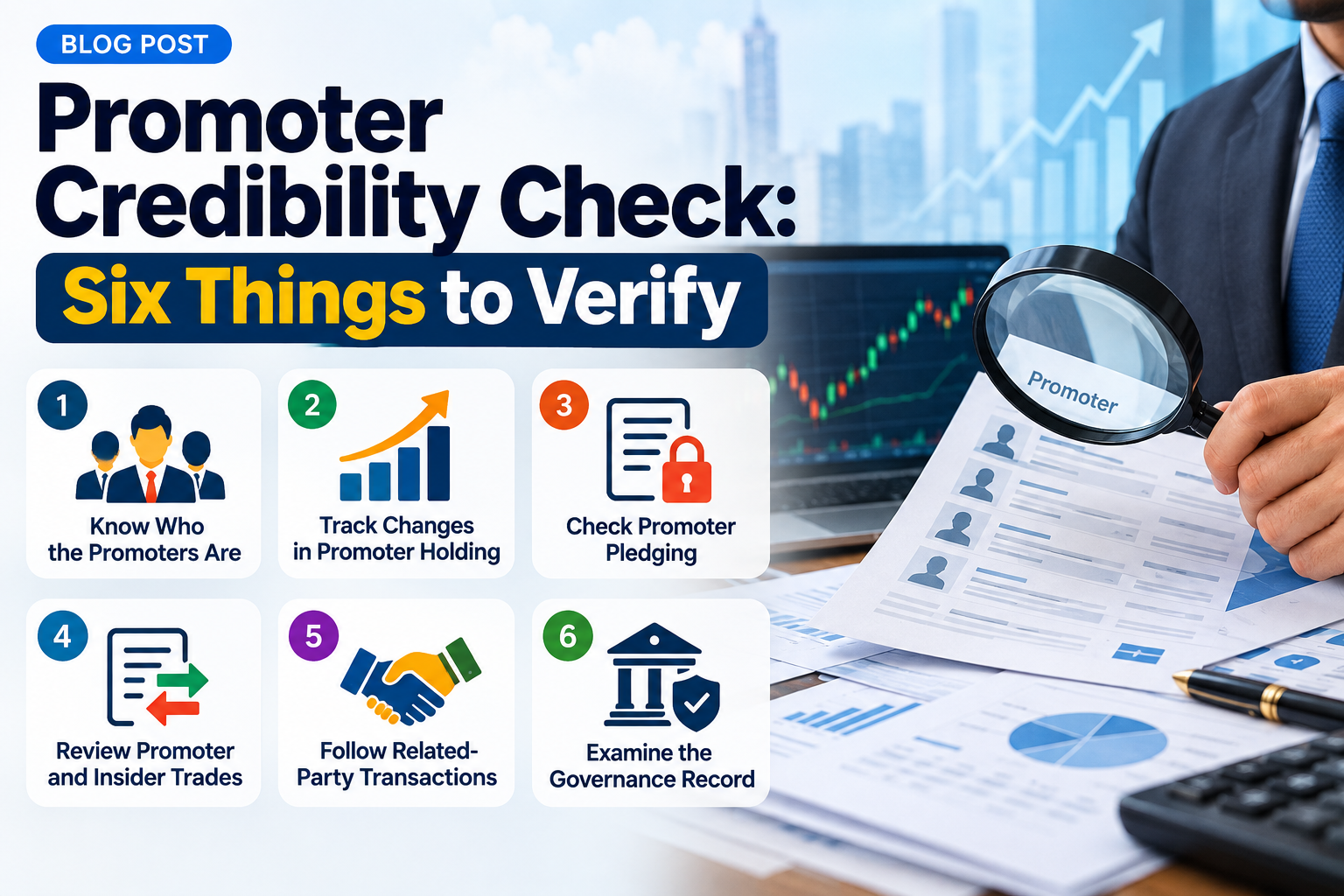
A promoter credibility check starts with evidence, not reputation. Six things are on the public record for every listed company: who the promoters are, how their holding has changed, whether it is pledged, how they have traded, how the company deals with parties connected to them, and what the wider governance record shows. The aim is not to label anyone good or bad. It is to know which filing deserves a closer look.
Each check below says what to look for and where it is filed. Four of the six have a longer post of their own, worked on a real filing, and we link to it where it exists.
1. Confirm who the promoters actually are
“Promoter” is a disclosure category, not a description of the founder or the public face of a business. The list a company files can include individuals, family members, holding companies and trusts, and it is often longer than the name you had in mind.
The quarterly shareholding pattern sets it out: every person and entity under Promoter and Promoter Group, and what each one holds. It is filed within 21 days of each quarter ending.
Ask one thing. Does the disclosed structure match the picture you had? If it does not, understand the difference before going further.
2. Trace how the holding has changed
One percentage tells you where ownership stands today. The useful question is what it did over the last four or five quarters, and why.
The direction alone settles nothing. A percentage has a denominator, so it can move without a promoter buying or selling a share. In one case we worked through, a company bought back about one share in forty, its promoters tendered none, and their percentage still fell.
The method, with a worksheet, is in our five-minute promoter shareholding check.
3. Check whether the holding is pledged
A holding can look large on paper while part of it is pledged to a lender. The shareholding pattern carries a column for shares pledged or otherwise encumbered, and a promoter has to disclose a new pledge, a release or a lender selling the shares within seven working days.
Read the pledged portion as a share of what the promoters hold, not as a raw number, and read it across several quarters. Once it passes more than half their shares, or more than a fifth of the company, the promoter also has to state the reason.
A pledge is not a verdict. We showed the same headline meaning opposite things in two real cases in what promoter pledging means, and when to worry.
4. Review what promoters and insiders have traded
When a promoter, director or senior employee trades more than ₹10 lakh of the company’s shares in a quarter, it is disclosed, under a heading you will see on the filing as Regulation 7(2). Each disclosure shows who traded, how many shares, by what mode, and the holding before and after.
Read the mode before the number. In a filing we took apart row by row, one promoter’s holding went from 2.27% to 0.00% in a day. It was a gift to five other promoters, and nothing was sold.
The six fields worth reading are in insider trading disclosures: what they signal.
All four of the checks so far rest on exchange filings, and you do not have to watch for them yourself. BSE publishes the filing. StockTool.AI’s plain-English summary is live one minute later, with the original source available for verification. The rest of the modules are on the StockTool.AI features page.
5. Follow the related-party trail
Credibility is also about how a company deals with people and entities connected to its promoters. Listed companies file their related-party transactions alongside their financial results, and the annual report carries a fuller note.
For each material one, record who the related party is, what the transaction was, how much it was for, and whether it recurs. Then compare with earlier periods. Has a new related party appeared? Has a familiar arrangement suddenly become much larger?
A related-party transaction is not a problem because it exists. Companies deal with connected entities for ordinary business reasons. The exercise is to know the relationship, the size and the purpose.
6. Look beyond ownership, at the governance record
The last check is the widest. Read what the company has disclosed about its board and management, and what has changed: directors joining or leaving, a change of auditor, an auditor’s qualification, a regulatory order, a filing corrected more than once.
Most of these arrive as exchange filings, often under the two least helpful category names on BSE, which we decoded in every BSE filing type explained in one line. Regulatory orders are published by SEBI on its own website.
Do not treat every change as a warning. Boards change, auditors rotate and companies restructure. Repeated inconsistencies deserve more attention than one administrative correction, and an order or a resignation should be read from the document itself, not from a headline about it.
Qualifications and a long business history belong here too, as one input. A strong background does not replace reading the disclosures.
The six checks, in one view
| Check | Where it is filed | The question |
|---|---|---|
| 1. Identity | Quarterly shareholding pattern | Who exactly is in the promoter group? |
| 2. Ownership | Shareholding patterns, four or five quarters | How has the holding moved, and why? |
| 3. Pledging | Shareholding pattern and encumbrance disclosures | What share of the holding is pledged, and is it rising? |
| 4. Trades | Disclosures under Regulation 7(2) | Who traded, by what mode, and how often? |
| 5. Related parties | Filed with results, and in the annual report | Who are the connected parties, and what has changed? |
| 6. Governance | Exchange filings, the annual report, SEBI orders | Do the documents tell a consistent story? |
The checks are deliberately different, and no single one answers the question. Credibility is not a figure printed in any filing. It is what you can say after comparing several of them and following each point back to the document it came from.
If one answer is unclear, that is not a gap to fill with an assumption. It is the filing to open next.
Disclaimer
StockTool.AI is a research and information platform and is not a SEBI-registered investment adviser or research analyst. Its AI-generated insights are based on public filings, transcripts, annual reports and other publicly available information. Summaries may not be exhaustive or error-free, and the original source document should always be treated as authoritative. Nothing here is investment advice or a recommendation to buy, sell or hold any security. Any decision taken on the basis of this information is the reader’s own. Investments in securities are subject to market risks.