
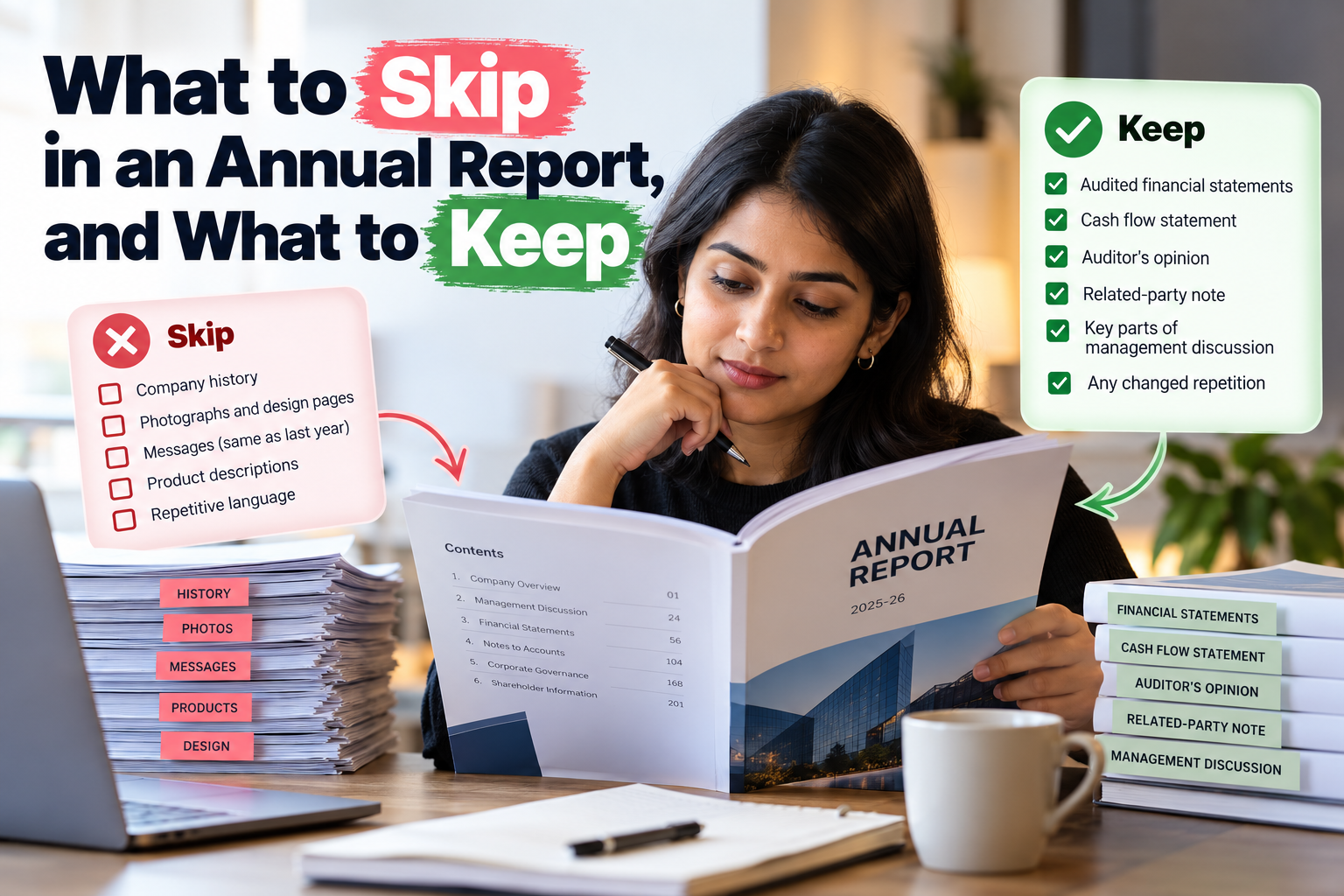
You can skip most of an annual report on a first read. Keep the audited financial statements, the cash flow statement, the auditor’s opinion, the related-party note and the few parts of the management discussion that the rules force the company to be specific about. Skim the history, the photographs and the messages that say what they said last year. The one thing you cannot skim is repetition that has changed.
Most writing on annual reports tells you what to read. This post is about the other half, because on a document of two or three hundred pages the decision that saves the most time is what to leave out, and the decision that costs the most is leaving out the wrong thing.
How to read one is already covered
Two earlier posts answer the question of what to read and in what order. How to Read an Annual Report Without Reading It All goes through the report section by section, from the table of contents to the borrowings note. The Five Pages of an Annual Report That Matter takes the five sections that carry the most weight, puts them in reading order and runs all five against one company’s report.
This post assumes you have a report open and are trying to decide what to leave alone.
Repetition is skippable. Repetition with a change is not.
An annual report is written once and then largely rewritten each year. The company history, the product descriptions, the governance language and the design pages are substantially last year’s, updated. That is why the document is long, and it is why most of it can be read at speed without losing anything.
The exception is the only rule you really need. If a section looks like last year’s but now contains a new number, a new qualification, an acquisition, a resignation, a litigation disclosure or a change in accounting policy, stop and read the new part properly.
Skipping repetition is not the same as skipping information.
Where you can, open last year’s report alongside this one. On the boilerplate the difference is nothing at all, which tells you to move on. Where there is a difference, that difference is usually the most interesting sentence on the page.
The parts the rules force the company to be specific about
The management discussion is the section readers argue about most. It is long, it is written by the company, and a good deal of it is general. It is also the one narrative section whose contents are prescribed rather than chosen.
SEBI’s listing rules set out what a management discussion has to cover: industry structure and developments, opportunities and threats, performance by segment or product, outlook, risks and concerns, internal control systems, a discussion of financial performance, developments on the human resources side, and the company’s key financial ratios.
That last item is the one most readers have never heard of, and it is the one that pays off fastest. If a key financial ratio moved by 25% or more against the previous year, the company has to explain the move. Any change in return on net worth has to be explained whatever its size.
So a vague-looking section contains a short list of specific answers, and the company had no choice about writing them.
Take Mahindra & Mahindra’s Integrated Annual Report 2025-26. Its management discussion sets out eight ratios for the company: debtors turnover, inventory turnover, interest coverage, current ratio, debt equity, operating profit margin, net profit margin and return on equity. Two of the eight carry an explanation.
Debt equity moved from 0.02 to 0.01, and the report gives the reason as “primarily due to repayment of borrowings and higher equity base”. Interest coverage moved from 62.0 to 77.8, “primarily due to higher Operating Profits”.
Source: Mahindra & Mahindra Limited, Integrated Annual Report 2025-26, Management Discussion and Analysis. Standalone figures for the company.
Now look at what is not explained. Inventory turnover went from 8.6 to 10.7, a rise of about 24%, and carries no explanation at all. Interest coverage rose about 25%, and does. The threshold decided which two sentences got written.
Both halves of that are useful. The explanations you do get are short, plain and worth reading, because they are the company saying in its own words which numbers moved far enough to need saying. The ones you do not get are not being withheld. They simply did not cross the line, and if a ratio matters to you, the statements are right there and you can work it out yourself.
The auditor’s opinion, which takes about a minute
Formal language makes this section look like filler. The first part of it is not.
Check whether the opinion is unmodified, or whether the auditor has added a qualification, an emphasis of matter or key audit matters. If anything is flagged, the auditor will point you at a specific note in the accounts, and that note has just become the most valuable page in the report.
The purpose is not to decide whether the company is a good one. It is to find out whether the person who audited the numbers wanted to say something about them.
The related-party note, which is easy to miss
Related-party transactions sit inside the notes and are rarely signposted, which is why they get skipped by readers who would have wanted to see them. They are worth a deliberate stop.
Record four things: who the related party is, what the transaction was, how much it was for, and what was still outstanding at the year end. Guarantees and commitments, where they are disclosed, get the same treatment.
A related-party transaction is not improper because it exists. A great many are ordinary business between a company and entities connected to it. The useful exercise is to know what was disclosed, not to form a view about why.
What you can safely skim
An annual report carries a lot of material that exists for legal or presentational reasons and does not need equal attention on a first pass:
- repeated company history
- generic corporate messages
- photographs and design-heavy pages
- product descriptions that have not changed
- routine declarations that add nothing new
- sections that reproduce information you have already read
None of this is unimportant in principle. It is unimportant at this moment, which is a different claim and a much smaller one.
Working out which sections of a particular report are which is most of the time cost of a first read. StockTool.AI’s AR Key Takeaways gives you a fast orientation on what a company’s annual report covers, so you can decide which sections deserve your own read. The rest of the modules are on the StockTool.AI features page. Get StockTool.AI on Android · on iOS
Keep a list. Do not chase each item as you find it.
The fastest way to lose an afternoon is to investigate every interesting thing the moment you meet it. Three pages in you are deep inside a tax note and you have forgotten what sent you there.
Write it down instead. A large increase in borrowings. A new related-party transaction. An auditor qualification. A major contingent liability. A significant acquisition. A sharp change in receivables. A new segment. A change in accounting policy.
Finish the pass, then work the list. That single habit turns a reading exercise into a research one, and it is the difference between finishing a report and finishing with something written down.
Keep management’s words and the audited numbers apart
An annual report contains both, and they are not the same kind of statement. “Demand remained strong” is management’s description. A revenue figure is an audited number. A sentence about future expansion is an expectation, and nothing has happened yet.
So when you write anything down, write it in three lines:
- Management said: demand improved during the year.
- Reported figure: revenue rose against the previous year.
- To verify: the segment disclosure that would move if that were true.
It costs a few extra seconds and it is worth them, because a note that mixes the three is a note you cannot trust a month later when you no longer remember which part was the company talking.
The split, in one pass
| Bucket | What goes in it |
|---|---|
| Keep, always | Audited financial statements, cash flow statement, auditor’s opinion, related-party note |
| Keep, because the rules make it specific | Key financial ratios and their explanations, segment or product performance, significant accounting changes |
| Open when a number sends you there | Notes on borrowings, receivables, provisions, contingent liabilities and tax |
| Skim | Repeated history, generic messages, design pages, unchanged product descriptions |
| Never skim | Anything repeated that now contains a change, however small it looks |
None of this says that some sections do not matter. It says they do not all matter at the same moment. A first pass is for finding out where a report is interesting. A second is for reading those parts properly, and it is much shorter than the first.
Do it that way and the three hundred pages stop being a reading problem. They become an index.
Disclaimer
StockTool.AI is a research and information platform and is not a SEBI-registered investment adviser or research analyst. Its AI-generated insights are based on public filings, transcripts, annual reports and other publicly available information. Summaries may not be exhaustive or error-free, and the original source document should always be treated as authoritative. Nothing here is investment advice or a recommendation to buy, sell or hold any security. Any decision taken on the basis of this information is the reader’s own. Investments in securities are subject to market risks.