
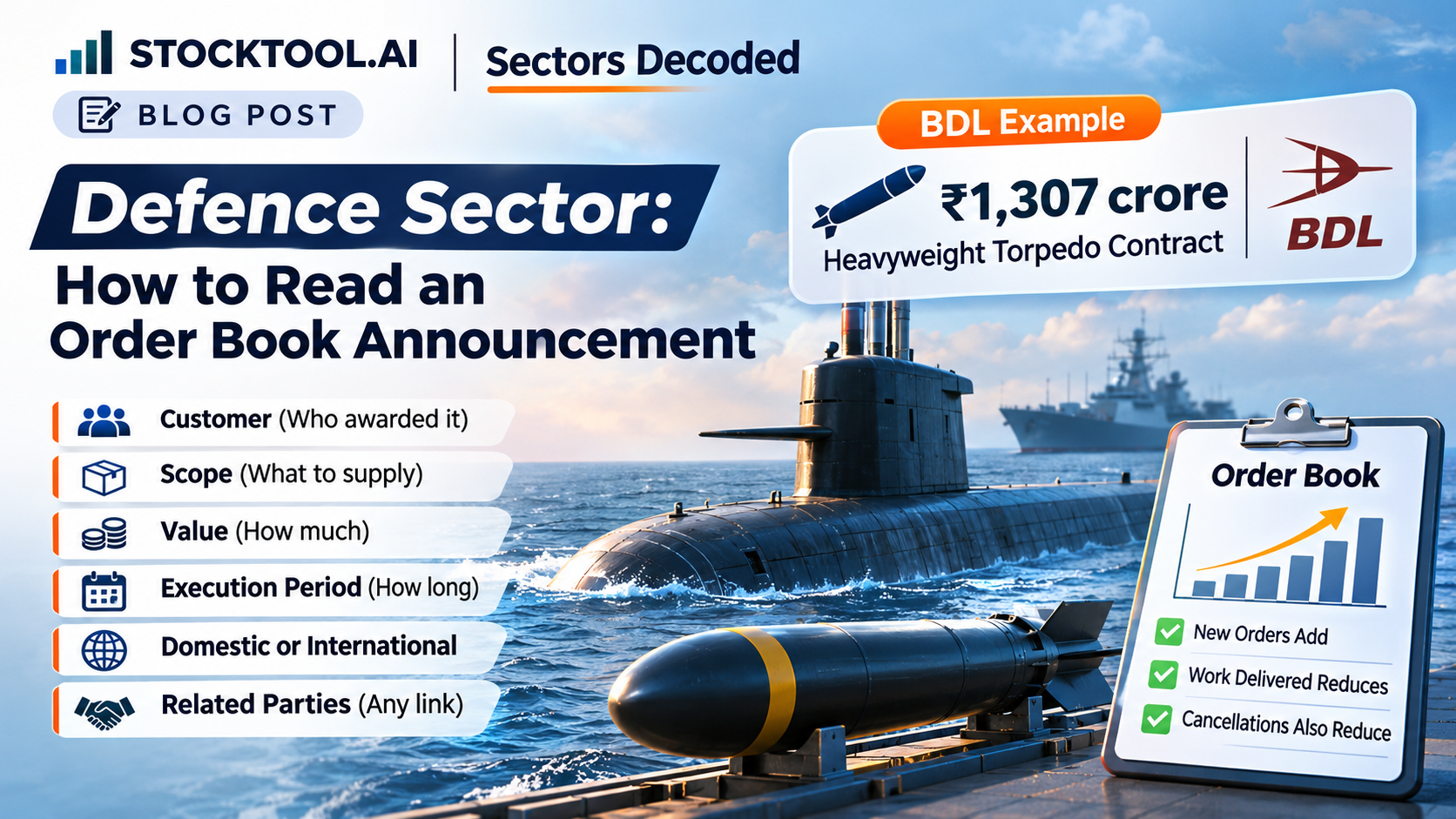
A defence order book announcement tells you who awarded a contract, what must be supplied, its value and how long the company has to deliver. The order adds to the order book: the value of orders received but not yet executed. It is not revenue. Revenue is earned only as the work is delivered.
Defence manufacturers build equipment over years, so the gap between an order and revenue is wide. This guide reads one real filing: a contract that Bharat Dynamics Limited (BDL) announced on 15 October 2026. BDL is a Government of India enterprise under the Ministry of Defence that makes missiles, torpedoes and related equipment; it reported a net sales turnover of ₹2,442 crore for the year to March 2026, according to its Annual Report 2025-26 (page 2).
What an order announcement tells you
Listed companies must tell the stock exchanges about material events under Regulation 30 of SEBI’s listing rules (the Listing Obligations and Disclosure Requirements Regulations, 2015). A significant order is one of them, and the rules set the questions the filing must answer. Our guide to order win announcements and what counts as material explains the materiality test. The answers to look for:
- Customer: the ministry, armed force, public-sector body or other organisation awarding the order.
- Scope: the equipment, product or service to be supplied.
- Value: the stated amount, and whether it includes or excludes taxes.
- Execution period: the time allowed to complete the contract.
- Domestic or international: whether the customer is in India or abroad.
- Related parties: whether the promoter group has an interest in the customer, and whether the order is a related-party transaction, that is, a deal with a party connected to the company.
The wording matters too. A signed contract is a firm commitment. A letter of intent says the customer intends to place an order, and the contract may follow later. A framework agreement sets terms for future orders without promising that any particular amount will be bought. Read the filing’s own words rather than a headline’s “order win”.
One real filing: BDL’s heavyweight torpedo contract
On 15 October 2026, BDL told NSE and BSE that it had signed a contract that day to supply heavyweight torpedoes: large torpedoes launched from submarines or ships. The filing answers the rules’ questions in a table:
| What the filing asks | What BDL disclosed |
|---|---|
| Entity awarding the contract | Indian Navy |
| Significant terms, in brief | Supply of Heavyweight Torpedoes |
| Nature of the order | Receipt of order |
| Domestic or international | Domestic |
| Time period for execution | To be completed within 42 months |
| Size of the order | ₹1,307 crore plus taxes (approximately, per the cover letter) |
| Promoter group interest in the customer | No |
| Related-party transaction | No |
Source: Bharat Dynamics Limited, “Receipt of orders”, Ref. BDL/CS/2026/SE-55, filed with NSE and BSE on 15 October 2026, pages 1 and 2.
That tells you who, what, how much and how long. It does not give a delivery schedule, payment milestones or when revenue will be recognised. So nobody can divide the ₹1,307 crore into quarters from this filing. It is a notice that an order was received, not the contract itself.
Nor should the full ₹1,307 crore be expected in the next quarter’s revenue. The 42 months give the broad window for the work, which runs well beyond the quarter in which the contract was signed.
Defence companies announce orders like this one through the year, and each needs this kind of read. StockTool.AI’s exchange filing AI summaries help with the first pass: BSE publishes the filing, and StockTool.AI’s plain-English summary is live one minute later, with the original source available for verification.
How a new order enters the order book
An order book is the value of confirmed orders a company has received but not yet executed. New orders add to it; work delivered, and any orders cancelled or cut short, take it down. As a rough identity:
Closing order book = opening order book + new orders received − orders executed, cancelled or otherwise reduced
That is a way to understand the movement, not a substitute for the company’s own figures. Companies define and report their order books differently.
BDL’s annual report gives the pieces for the year to March 2026, in ₹ crore:
| Line | ₹ crore | Where in the annual report |
|---|---|---|
| Order book at 31 March 2025 | 22,814 | Page 10 |
| New orders received in 2025-26 (about) | 5,909 | Page 13 |
| Order book at 31 March 2026 (approximately) | 26,176 | Pages 13, 18 and 54 |
| Sales turnover in 2025-26 | 2,442 | Pages 2 and 16 |
Source: Bharat Dynamics Limited, Annual Report 2025-26, printed page numbers.
Add the opening order book and the new orders and you get ₹28,723 crore. The order book closed at ₹26,176 crore, so about ₹2,547 crore left it during the year through execution and other changes. The annual report does not give the reconciliation, so the split between work delivered and anything else is not known from it.
Two more details from the same report show why the order book and revenue are different things. First, the order book grew while sales turnover fell, from ₹3,345 crore to ₹2,442 crore; the report says revenue “moderates to ₹2,442 crore on delivery phasing” (page 10). Second, it lists order cancellations as a risk, saying that cancellation “can weaken the order book and future revenue” (page 56). An order book can shrink without any work being done.
One last check before adding a new order to an order book figure: the torpedo contract is stated “plus taxes”, and the annual report does not say whether its order book includes taxes. And the ₹26,176 crore is a March figure. Adding October’s ₹1,307 crore to it would not give a verified current balance, because six months of execution and other orders sit in between. Wait for the company’s next order book disclosure.
What to check after the announcement
1. Execution updates.
Later filings may report deliveries, changes in scope, completion or a revised schedule. Read them alongside the original order.
2. The order book date.
An order book is a figure at a date. Check whether it was reported before or after the order you are reading.
3. Revenue in the results.
As work progresses, read reported revenue against the company’s disclosures on deliveries. Do not expect the full order value in one results period.
4. Firm order or potential business.
A signed contract is not a letter of intent or a framework agreement. The filing’s wording says which it is.
5. One customer or many.
BDL’s annual report lists high dependence on the Ministry of Defence as a risk (page 56). In defence, the customer is often a single government buyer, and its budgets and priorities shape the order book. Our aerospace sector post reads customer concentration in another part of the supply chain.
What an order book can tell you, and what it cannot
An order book shows the scale of contracted work still to be done. It cannot tell you when each rupee will become revenue, whether delivery will run to schedule, what margin the work will earn or when the cash will arrive. Those answers come from later filings and the financial statements.
The BDL torpedo contract is one worked example of reading a defence order announcement. It is not a view on BDL, its prospects or its share. To find order filings among everything a company files, our guide to every common BSE filing type helps, and terms such as order book and related-party transaction are in our beginner’s glossary. Read the announcement first, then follow the order through later filings. An order book is work still to be done, not revenue already earned.
Disclaimer
StockTool.AI is a research and information platform. It is not a SEBI-registered investment adviser or research analyst, and nothing here constitutes investment advice or a recommendation to buy, sell or hold any security.
All insights are AI-generated from publicly available filings, transcripts, annual reports and news. They are summaries, not complete records. They are not exhaustive, and the source document always governs. Information may contain errors or omissions, and data may be delayed or incomplete.
Any investment decision you make is entirely your own. You are responsible for validating every piece of information you rely on against primary sources before acting on it. We accept no liability for any decision taken, or loss incurred, on the basis of anything published here.
Investments in securities markets are subject to market risks. Read all related documents carefully before investing.