
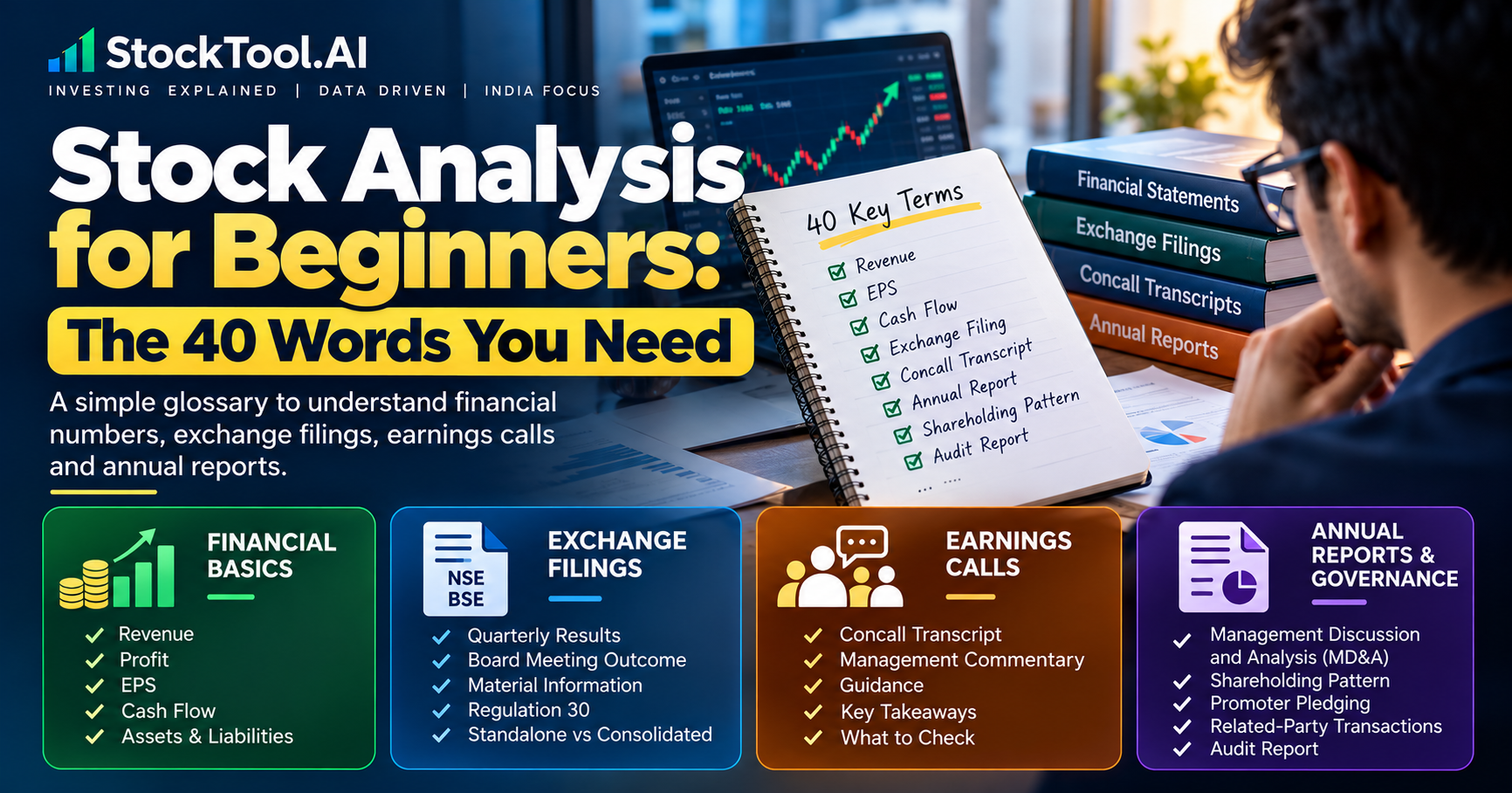
Stock analysis for beginners starts with vocabulary. Results, exchange filings, concall transcripts and annual reports use the same few dozen terms again and again. This glossary defines 40 of them in plain English, in four groups: the financial numbers, exchange filings, earnings calls and annual reports, and corporate governance.
Each definition is a starting point for reading a document, not a conclusion about a company. Look a term up when you meet it, then see how the document uses it. The glossary sits under our guide How to Analyse a Stock Knowing Almost Nothing, and where we have written a full post on a term, the definition links to it.
1. Financial basics: understand the numbers
These ten terms describe what a company earns, spends, owns and owes.
1. Revenue
The money a company earns from selling goods or providing services, before expenses are deducted. Compare revenue across periods and check what caused it to change.
2. Revenue growth
The percentage increase or decrease in revenue over a stated period. Always check the comparison period and whether the figures cover the same business.
3. Profit
What remains after expenses are deducted from income. A report shows several profit lines, so check whether a figure is operating profit, profit before tax or profit after tax.
4. Profit after tax (PAT)
The profit remaining after tax. It is an important reported measure, but it does not tell you how much cash the business generated.
5. Earnings per share (EPS)
Profit after tax that belongs to shareholders, divided by the number of shares, usually the average number in issue over the period. If a company issues more shares, EPS can fall even while profit rises.
6. Operating margin
Operating profit as a percentage of revenue: how much operating profit the company makes on each ₹100 of revenue, before interest, tax and items outside operations.
7. Cash flow
The movement of cash into and out of a business during a period. It can differ from reported profit, because a sale can be booked before the customer pays.
8. Debt
Money a company has borrowed from banks, bondholders or other lenders. Check the amount, interest cost and repayment dates rather than treating the total alone as the whole picture.
9. Assets
What a company owns or controls that appears in its accounts: cash, equipment, buildings, inventory and amounts customers owe.
10. Liabilities
What a company owes: borrowings, amounts due to suppliers and employees, and other obligations disclosed in the accounts.
2. Exchange filings: understand what was disclosed
Listed companies must tell the stock exchanges, NSE and BSE, about their results and important events. These terms help you identify what a filing contains and why it exists.
11. Exchange filing
A document a listed company submits to NSE or BSE, which the exchange publishes with a date and time. It is the primary record: if a news report and a filing differ, the filing is the source. Our guide: Every Common BSE Filing Type, Explained in One Line.
12. Corporate announcement
A company disclosure about an event, decision or development. The title is only a starting point; read the details to see what has actually been announced.
13. Quarterly results
Financial results for a three-month period, usually shown beside earlier periods. Check whether the figures are standalone or consolidated before comparing them. Our guide: Results Day Checklist: What to Read, in What Order.
14. Standalone results
Results for the listed company alone, without its subsidiaries. They can look quite different from the group’s consolidated results.
15. Consolidated results
Results that combine the parent company with its subsidiaries, giving the picture for the whole group.
16. Board meeting outcome
A filing describing what the board decided at a meeting: results, appointments, dividends or other matters. Separate what was decided from what was only proposed. Our guide: Board Meeting Outcome: How to Read One in Two Minutes.
17. Material information
Information significant enough to affect how an investor sees the company, which the rules require it to disclose. Some events must always be disclosed; others only when they pass the company’s materiality test.
18. Regulation 30 disclosure
A filing under Regulation 30 of SEBI’s Listing Regulations, the rule that requires a listed company to tell the exchanges about material events, such as an acquisition, a change in senior management or a large order. Read the filing for the event and its stated details.
19. Shareholding pattern
A quarterly filing showing who owns the company’s shares, by category: promoters, institutions and the public. Comparing quarters shows how ownership is changing. Our guide: Shareholding Pattern Changes: How to Read Them.
20. Insider trading disclosure
A filing reporting a trade in the company’s shares by a promoter, director, employee or other designated person. The type, person, date and mode matter; the filing alone does not explain why the trade was made. Our guide: Insider Trading Disclosures: What They Signal.
This is where the terms start to earn their keep. StockTool.AI’s exchange filing AI summaries put each announcement into plain English: BSE publishes the filing, and StockTool.AI’s plain-English summary is live one minute later, with the original source available for verification. The words above are what you need to read that summary critically and check it against the filing.
3. Earnings calls and annual reports: find the explanation
Financial statements show the numbers. Earnings calls and annual reports supply the explanations and the detail behind them.
21. Concall
Short for conference call: usually the call after results where management discusses performance and answers questions from analysts.
22. Concall transcript
The written record of that call. It lets you search management’s comments, review the questions asked and compare the answers with other disclosures. Our guide: How to Read a Concall Transcript in 15 Minutes.
23. Management commentary
What management says about performance, conditions, plans or risks. Treat it as management’s explanation, then compare it with reported results and later disclosures.
24. Guidance
Management’s indication of expected future performance, as a range, a target or a description. It is not a guarantee.
25. Annual report
The yearly publication containing the business review, financial statements, auditor’s report and other required disclosures. Our guide: How to Read an Annual Report Without Reading It All.
26. Management Discussion and Analysis (MD&A)
The section of the annual report where management discusses the business, performance and risks. Compare its explanations with the financial statements rather than accepting them as proof. Our guide: Management Discussion and Analysis in an Annual Report: How to Spot What Is Missing.
27. Auditor’s report
The independent auditor’s opinion on whether the financial statements give a fair picture. Read the opinion and any qualification or highlighted matter.
28. Notes to accounts
The explanations that accompany the financial statements: accounting policies, breakdowns of balances, transactions and items the headline figures do not show.
29. Cash flow statement
The statement that groups cash movements into operating, investing and financing activities, showing how cash was generated and used during the period.
30. Contingent liability
A possible obligation that depends on a future event, such as the outcome of a tax dispute or court case, disclosed in a note rather than counted as a liability. Read the note for its nature and amount. Our guide: Contingent Liabilities in an Annual Report: How to Read Them.
4. Corporate governance: understand ownership and accountability
Corporate governance is how a company is directed, monitored and held to account. These terms cover ownership, oversight and relationships that may need a closer read.
31. Promoter
The founder, family or group that controls the company and is named as its promoter in filings. Promoters usually hold a large stake and can shape the company’s decisions.
32. Promoter holding
The share of the company held by its promoters, shown as a percentage and a number of shares. Compare both figures across quarters. Our guide: Promoter Shareholding Check: A Five-Minute Method.
33. Promoter pledging
When promoters offer their shares to a lender as security for a loan. Check the number pledged, the total holding and the change over time; the filing alone does not give the reason. Our guide: What Does Promoter Pledging Mean and When Should You Worry?.
34. Related-party transaction
A transaction between the company and a party connected to it, such as a promoter, director, subsidiary or a business they control. Read who is involved, what it covers, its value and the approvals. Our guide: Related-Party Transactions, Explained With a Real Case.
35. Independent director
A board member with no material relationship with the company or its promoters, appointed to provide independent oversight. The label does not show how well the role is performed.
36. Audit qualification
An audit opinion in which the auditor says the accounts are fairly stated except for a specific matter, which it describes. Read the stated basis and the note it refers to. Our guide: What Does an Auditor Qualification Mean in a Results Filing?.
37. Auditor resignation
When an auditor steps down before completing its term. The resignation filing and any explanation attached to it are the sources; do not assume a reason the documents do not give. Our guide: Auditor Resignation Filing: Why It Outweighs Ten Press Notes.
38. Insider
Under SEBI’s insider trading rules, either a connected person or anyone who has, or has access to, unpublished price-sensitive information, however they came by it. A connected person is anyone associated with the company, directly or indirectly, in the previous six months, such as a director, officer, employee or someone with a professional or business relationship with it; holding companies, subsidiaries, associates and immediate relatives are included. The rules restrict insiders from trading while they hold such information.
39. Unpublished price-sensitive information (UPSI)
Information relating, directly or indirectly, to a company or its securities that is not generally available and would materially affect the share price if it became generally available. Results before they are announced are the familiar example. Our guide: What a Trading Window Closure Actually Tells You.
40. Corporate governance
The structures, processes and responsibilities through which a company is directed and overseen. Governance disclosures show board oversight, accountability and the company’s relationships.
How to use these 40 terms when researching a company
Do not try to memorise the glossary in one sitting. Use it as a reference when a term appears in a results announcement, a concall transcript, an annual report or a governance filing. A simple routine is enough:
- Start with the document. Identify whether you are reading quarterly results, an exchange announcement, a concall transcript or an annual report.
- Look up unfamiliar terms. Understand the language before drawing conclusions from the numbers.
- Compare like with like. Check the reporting periods and whether figures are standalone or consolidated.
- Follow the disclosure trail. If a statement raises a question, look for the filing, note or management explanation that answers it.
- Verify the source. An AI-generated summary can help you find information, but it may leave out context or contain errors. The original document is the reference.
The goal is to understand the language, not predict the outcome
Knowing these 40 terms makes company disclosures easier to follow. It will not remove uncertainty or tell you what a share will do next. Revenue growth, debt, promoter holding and auditor commentary all need reading in context, against the underlying documents and the period they cover.
Start with one term you do not understand, find it in a real disclosure and read the paragraphs around it. That habit is worth more than memorising definitions you have never seen used.
Disclaimer
StockTool.AI is a research and information platform. It is not a SEBI-registered investment adviser or research analyst, and nothing here constitutes investment advice or a recommendation to buy, sell or hold any security.
All insights are AI-generated from publicly available filings, transcripts, annual reports and news. They are summaries, not complete records. They are not exhaustive, and the source document always governs. Information may contain errors or omissions, and data may be delayed or incomplete.
Any investment decision you make is entirely your own. You are responsible for validating every piece of information you rely on against primary sources before acting on it. We accept no liability for any decision taken, or loss incurred, on the basis of anything published here.
Investments in securities markets are subject to market risks. Read all related documents carefully before investing.