
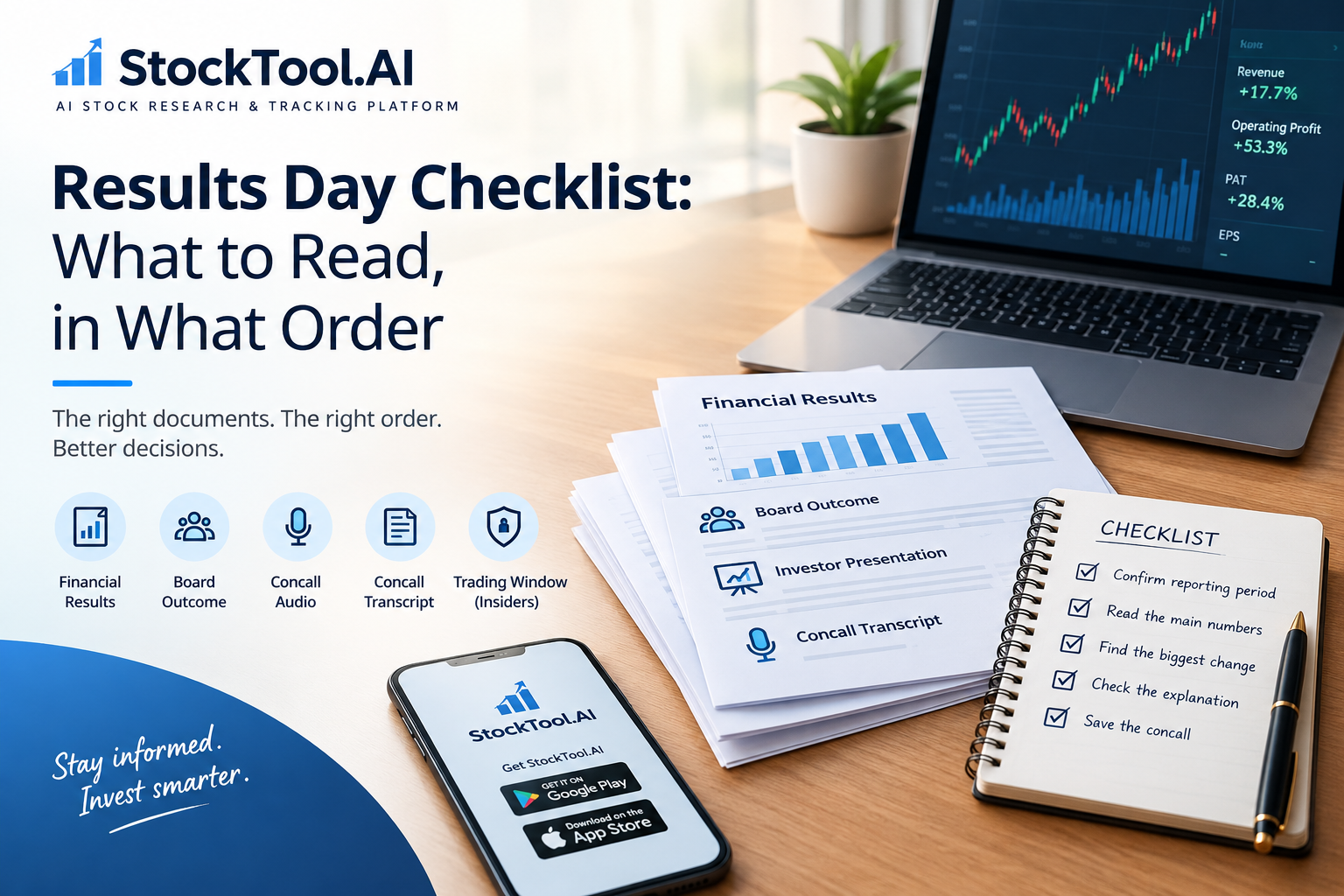
Results day can leave you with several documents open at once: the financial results, a board outcome, an investor presentation and, a few days later, a concall transcript. Read them in sequence. Confirm the reporting period, read the main numbers, find the biggest change, check the explanation, and save the concall for whatever is still unanswered.
Results day is less about reading everything and more about reading the right document at the right time. That starts with knowing when each one arrives.
When each document arrives
None of these documents turns up whenever a company feels like it. Each runs on its own clock.
| Document | When it arrives |
|---|---|
| Quarterly financial results | Within 45 days of the quarter ending. 60 days for the full year |
| Board meeting outcome | Within 30 minutes of the meeting closing, or within three hours if it ends after the market has closed |
| Earnings call audio | Before the next trading day begins, or within 24 hours of the call, whichever is earlier |
| Earnings call transcript | Within five working days of the call |
| Trading window for insiders | Reopens 48 hours after the results are declared |
So results and the board outcome usually land together, often in the evening, the audio follows within a day and the transcript within the week. We have explained the thirty-minute clock on board outcomes and what the trading window closure tells you in earlier posts.
When the filing does arrive, you do not have to be watching for it. BSE publishes the filing. StockTool.AI’s plain-English summary is live one minute later, with the original source available for verification. The rest of the modules are on the StockTool.AI features page. Get StockTool.AI on Android · on iOS
Start by confirming what was actually reported
Before deciding whether the numbers went up or down, check what they are numbers for.
Which quarter is it? Are the figures standalone or consolidated? Is the comparison against the same quarter last year, the previous quarter, or both? And what unit is the company using?
That last one catches people out more than it should. Tech Mahindra’s release for the June quarter gives some figures in crore and others in million, on the same page. Neither is wrong. Mixing them in your own notes is.
If you want to confirm the period and find the company’s submitted results, NSE keeps a financial results section searchable by company.
Read the headline numbers before anyone explains them
Take four numbers, and nothing else, on the first pass: revenue, operating profit, profit after tax and earnings per share. Do not open the management commentary yet. Find out what changed before you read why.
Here is Tech Mahindra’s June quarter, announced on 16 July 2026:
| Consolidated, Q1 FY27 | Reported | Change on Q1 FY26 |
|---|---|---|
| Revenue | ₹15,712 crore | Up 17.7% |
| Operating profit (EBIT) | ₹2,264 crore | Up 53.3% |
| Profit after tax | ₹1,465 crore | Up 28.4% |
| Earnings per share, diluted | ₹16.50 | Not stated in the release |
Source: Tech Mahindra, Q1 FY27 results release, 16 July 2026. Revenue converted from ₹157,119 million as printed.
Three numbers, three different growth rates, one quarter. Which one you read first decides the story you tell, and that is precisely why you read all four before you read a word of explanation.
Follow the biggest change, not every number
Once the headline figures are clear, look for the two or three movements that need explaining. The numbers do not tell you the story. They tell you where to look.
In Tech Mahindra’s case, there are two.
Operating profit grew about three times as fast as revenue. That can only happen if the business kept more of each rupee it earned, and the release says so: an EBIT margin of 14.4%, up about 330 basis points on the year. So the first question is what moved the margin.
Profit after tax then grew a little over half as fast as operating profit. Something between the operating line and the bottom line absorbed part of the gain. The usual candidates are tax, other income, finance costs and exceptional items, and the full results statement shows which.
We are deliberately not telling you the answer. Finding the three numbers took two minutes. Finding the reason is the reader’s own work, and the point of the method is that you now know exactly which line to go and read.
Check cash flow, exceptional items and segments
Where the quarterly filing includes cash flow information, see whether cash from operations broadly supports the reported profit. You are not calculating ratios on results day. You are looking for a mismatch worth coming back to.
Then check exceptional or one-off items. A large gain or charge can move reported profit without saying anything about how the business normally performs.
For a company with several segments, look at them before relying on the total. Overall growth can hide one segment weakening while another carries the result.
And keep reported facts apart from explanations. “Revenue increased 17.7%” is a reported number. “Revenue increased because of strong demand” is an explanation, and it belongs to whoever said it.
Use management commentary to explain the movement
Only now open the investor presentation or the results commentary. The document has a job: explain the movements you have already found.
If margins rose, look for what management says about pricing, costs, utilisation or mix. If a segment slowed, look for demand, volumes or a particular client or geography.
Management commentary is one source of explanation. It is not an independent check on the numbers, and it was written by the people whose results they are.
Read the board outcome separately
The board outcome can carry decisions that have nothing to do with the quarter’s numbers: dividends, appointments, fund raising, acquisitions. Read it as its own document, even when it arrives in the same filing.
Read the verbs especially. A final dividend on results day is usually recommended, not declared, and goes to shareholders for approval. An interim dividend is declared by the board. We walked through the five verbs that matter, on a real filing, in how to read a board meeting outcome in two minutes.
This is also why the filing title matters. Financial Results, Outcome of Board Meeting, Investor Presentation and Earnings Call Transcript are different documents, and knowing which one you are opening tells you what it should contain.
Save the concall for the questions the numbers cannot answer
The concall is most useful after you have read the results, because by then you know what you are listening for.
If margins moved, listen for the explanation. If a segment slowed, listen for demand and pricing. If spending rose, listen for what it was for and when it is meant to pay back.
You do not need every minute of a long call. We took one transcript apart in full, GAIL’s for the same quarter, in how to read a concall transcript in 15 minutes.
The five-minute version
If you are short of time:
- Minute 1: confirm the quarter, the basis and the comparison.
- Minute 2: read revenue, operating profit, profit after tax and EPS.
- Minute 3: pick the two or three biggest movements.
- Minute 4: check cash flow, exceptional items and segments.
- Minute 5: read the board outcome, and write down what the concall needs to answer.
It is a filter, not a substitute for reading a material disclosure. If something still does not make sense after five minutes, that is the thing to read properly.
Results arrive four times a year and the companies change every time. The reading order does not. Numbers first, then the biggest change, then the explanation, then the questions.
Disclaimer
StockTool.AI is a research and information platform and is not a SEBI-registered investment adviser or research analyst. Its AI-generated insights are based on public filings, transcripts, annual reports and other publicly available information. Summaries may not be exhaustive or error-free, and the original source document should always be treated as authoritative. Nothing here is investment advice or a recommendation to buy, sell or hold any security. Any decision taken on the basis of this information is the reader’s own. Investments in securities are subject to market risks.