
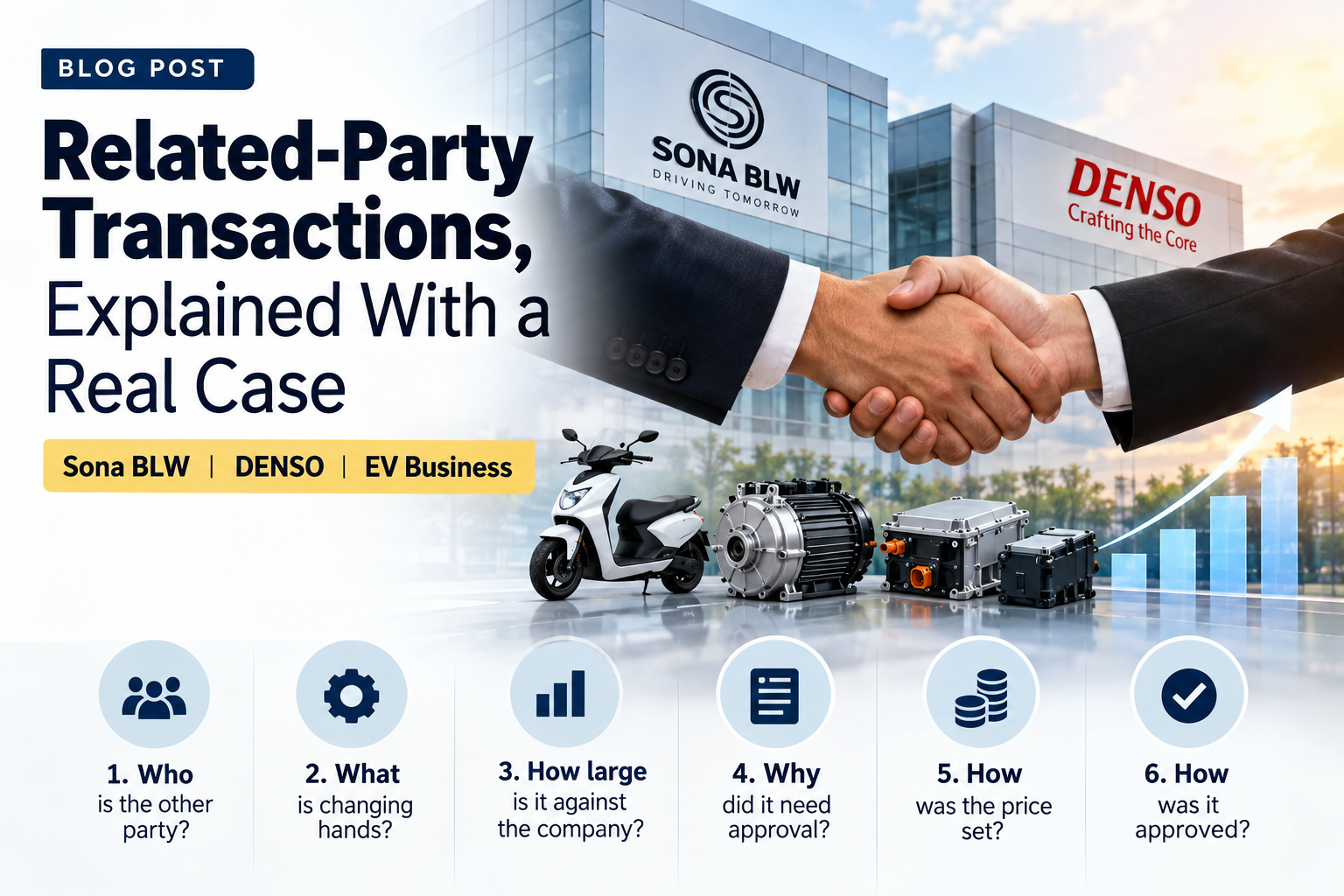
A related-party transaction is a deal between a listed company and someone connected to it. It is not a problem because it exists. To read one, you need six answers: who the other party is, what is changing hands, how large it is against the company, why it needed approval, how the price was set, and how it was approved. A filing from this week answers all six, and it has a twist that teaches more than a typical case would.
What makes a transaction related-party
The other side of the deal is connected to the company: a subsidiary, a promoter or a promoter-controlled business, a director or an entity a director has an interest in. The deal itself can be almost anything: a sale of goods, a loan, a guarantee, a lease, or the transfer of a whole business.
The relationship is what makes it worth reading, because the two sides are not fully independent of each other. That is a reason to read carefully, not a reason to assume anything.
The case: Sona BLW and its EV business
On 22 July 2026, the board of Sona BLW Precision Forgings approved moving its electric vehicle business for two- and three-wheelers, which makes traction motors, inverters and related systems, into Sona Comstar eDrive, a company it owns outright. The postal ballot notice sets out the terms.
- The business moves as a going concern, for ₹893.2 crore.
- About ₹857.5 crore is paid in cash, and the rest in new shares of Sona eDrive.
- DENSO Corporation, a global manufacturer of automotive components based in Japan, then invests in Sona eDrive at a valuation of ₹1,750 crore, for 49%.
- Sona BLW keeps 51%. Sona eDrive stops being wholly owned and stays a subsidiary.
Why it needed a shareholder vote at all
This is the part worth slowing down for. A deal between a listed company and its own wholly owned subsidiary normally does not need shareholders’ approval, because the subsidiary’s accounts are already folded into the company’s own. Moving a business into a company you own outright is, in that sense, moving it from one pocket to another.
This one is different, and the notice says why in plain terms: the company’s shareholding in Sona eDrive “shall be diluted down to 51%”, and the transaction “can not be considered in the ordinary course of business”. Once DENSO owns 49%, the business is no longer moving between two pockets. Nearly half of what goes into the subsidiary will belong to someone else.
Wholly owned today, joint venture tomorrow. That is the reason for the vote.
The resolution also asks shareholders to approve and ratify, not only approve. The transfer agreement was signed on 22 July, before the vote, which is why the word ratify is there.
Is it material?
A related-party transaction needs shareholders’ approval when it is material, and the line depends on the company’s size. For a company with consolidated turnover of up to ₹20,000 crore, a deal is material once it passes 10% of that turnover.
Sona BLW’s consolidated turnover for the year to March 2026 was ₹4,449.46 crore, so the line is about ₹445 crore. The notice puts the transaction at 20.07% of turnover, roughly twice the line.
Material means a threshold was crossed. It does not mean misconduct.
How the price was set
The ₹893.2 crore comes from an independent valuation by Deloitte India Valuation LLP, which combined a discounted cash flow method with comparable-company multiples and arrived at a range of ₹869.4 crore to ₹918 crore. The company used the midpoint. The audit committee and the board state that they consider the terms fair and at arm’s length, and the notice links the valuation report for shareholders to inspect.
A valuation is evidence to read, not a verdict to accept. What it gives you is the method and the range, which is more than most related-party deals disclose.
How it was approved
Voting ran by remote e-voting from 4 September to 3 October. According to the scrutinizer’s report filed on 6 October, the ordinary resolution passed with 94.49% of votes cast in favour and 5.51% against. About 60% of all shares were voted. Institutions voted 94.43% in favour.
The promoter group, which holds about 28% of the shares, cast no votes at all. That is not a choice to read anything into. The rules bar every related party of the company from voting to approve a material related-party transaction, whether or not they are party to that particular deal, and the notice says so.
One more disclosure answers the conflict question directly. The notice records that one of the company’s whole-time directors is also a non-executive director of Sona eDrive and holds a single share in it. That is exactly the kind of line a reader should look for, and here it is stated rather than left to be found.
Both documents in this case are exchange filings. BSE publishes the filing. StockTool.AI’s plain-English summary is live one minute later, with the original source available for verification. The rest of the modules are on the StockTool.AI features page.
What happens next
A vote approves a deal. It does not complete it. Closing adjustments, the DENSO investment and the final shareholding are all still to come, and each will arrive as a later filing. A related-party transaction is a trail, not a single document.
The six questions, in one view
| Question | In the Sona BLW case |
|---|---|
| Who is the related party? | Sona Comstar eDrive, a wholly owned subsidiary until DENSO invests |
| What is changing hands? | The two- and three-wheeler EV business, as a going concern |
| How large is it against the company? | ₹893.2 crore, 20.07% of consolidated turnover |
| Why did it need approval? | The subsidiary will be 49% owned by DENSO, and the deal is outside the ordinary course of business |
| How was the price set? | Independent valuation, a published range, the midpoint used |
| How was it approved? | By shareholders, with related parties barred from voting: 94.49% in favour |
Related-party dealings are the fifth of the six checks in our promoter credibility check, and the idea of the ordinary course of business comes up again in what counts as material in an order win.
Start with the relationship. Follow the money and the approvals. Keep what the filing says apart from what you think of it.
Disclaimer
StockTool.AI is a research and information platform and is not a SEBI-registered investment adviser or research analyst. Its AI-generated insights are based on public filings, transcripts, annual reports and other publicly available information. Summaries may not be exhaustive or error-free, and the original source document should always be treated as authoritative. Nothing here is investment advice or a recommendation to buy, sell or hold any security. Any decision taken on the basis of this information is the reader’s own. Investments in securities are subject to market risks.