
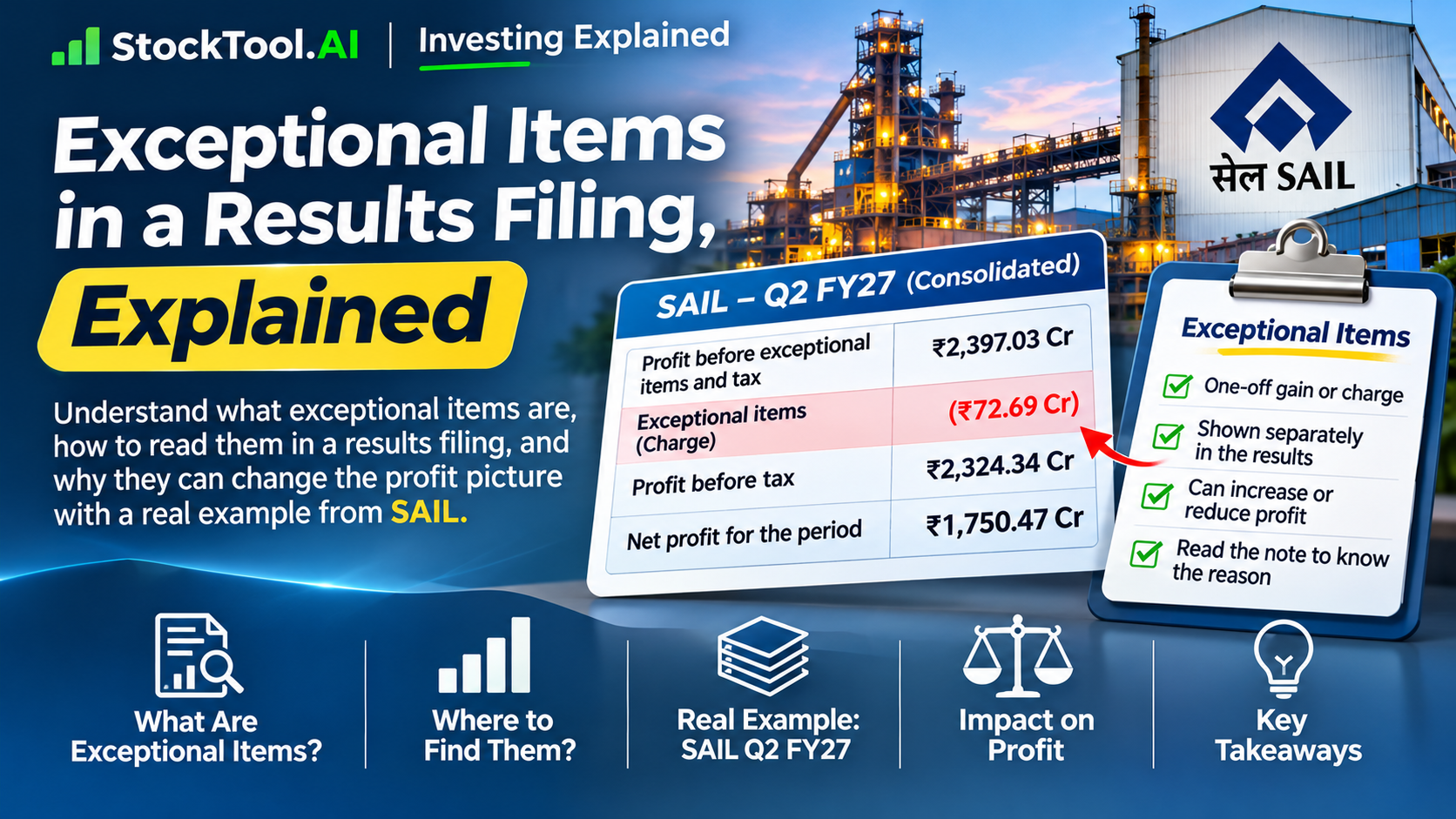
Exceptional items in a results filing are one-off gains or charges that a company shows on a line of their own, because of their size or nature. Read three lines together: profit before exceptional items and tax, the exceptional item, and profit before tax. Then read the note that says what the item was.
The line matters most when you compare quarters. A charge in one quarter and not in another, or a bigger one, can make profit growth look larger or smaller than the business behind it. This guide traces a real case: Steel Authority of India Limited (SAIL), whose board approved its results for the quarter ended 30 September 2026 on 27 October 2026, in a filing on NSE and BSE.
What is an exceptional item?
An exceptional item is a significant income or expense that a company presents separately in its results because of its nature or size. Separating it lets a reader see how much it moved the reported profit.
It can be a gain or a charge. A gain adds to profit: the sale of a building, say, or compensation from a legal settlement. A charge reduces it: restructuring costs, a large settlement, the impairment of an asset, or the cost of an unusual event. So an exceptional item is not necessarily an expense.
Nor does “exceptional” mean it will never happen again. The word describes how the item is presented, not how often it occurs. The note to the results says what it was, and earlier periods show whether something similar has appeared before.
Where does it appear in a results filing?
In the statement of profit and loss, usually as three lines close together. Read them as a set:
• Profit before exceptional items and tax: profit before the separately shown gain or charge, and before tax.
• Exceptional items: the amount shown separately. A charge is usually in brackets.
• Profit before tax (PBT): profit after the exceptional item, but before tax. A charge lowers it; a gain raises it.
The statement gives the amount. The note gives the reason. Without the note, you know how much but not what for.
A real example: SAIL, Q2 FY27
SAIL’s consolidated results, which cover the group including its share of joint ventures and associates, show the three lines like this, in ₹ crore:
| Line in the filing | Quarter to Sep 2026 | Quarter to Sep 2025 |
|---|---|---|
| Profit before exceptional items and tax | 2,397.03 | 894.58 |
| Exceptional items | (72.69) | (338.44) |
| Profit before tax | 2,324.34 | 556.14 |
| Net profit for the period | 1,750.47 | 418.72 |
Source: SAIL, statement of consolidated unaudited financial results for the quarter and half-year ended 30 September 2026, page 20 of the filing; notes on page 26.
This quarter, an exceptional charge of ₹72.69 crore took profit before tax from ₹2,397.03 crore to ₹2,324.34 crore.
Now the note. It says the exceptional items for the half-year, ₹216.70 crore, are compensation paid to employees under a voluntary retirement scheme. That is this quarter’s ₹72.69 crore plus ₹144.01 crore in the June quarter. For the same half-year a year earlier, the note says the ₹338.44 crore charge came from raising the gratuity limit from ₹20 lakh to ₹25 lakh, after dearness allowance rose above 50% of basic pay.
This is where the line changes the story. Profit before tax rose from ₹556.14 crore to ₹2,324.34 crore, about 4.2 times. Profit before exceptional items and tax rose from ₹894.58 crore to ₹2,397.03 crore, about 2.7 times. Both figures are correct. The first compares two quarters that carry different one-off charges, and the year-ago charge was the bigger one. The second compares them without either.
The filing also shows exceptional charges in every period it reports: the September 2025 quarter, the June 2026 quarter, this quarter, and ₹668.22 crore for the year to March 2026. This filing’s notes explain only the two half-years above. The label describes how each was presented; it does not mean nothing similar will come again.
The results are unaudited. The auditors carried out a limited review, a lighter check than a full audit. Their report draws attention to the voluntary retirement charge as an emphasis of matter and says their conclusion is not modified. Our guide to what an auditor qualification means in a results filing explains what a modified conclusion would look like.
Reading every results filing this closely as it lands takes time. StockTool.AI’s exchange filing AI summaries help with the first read: BSE publishes the filing, and StockTool.AI’s plain-English summary is live one minute later, with the original source available for verification.
What happens when the exceptional item is a gain?
The arithmetic runs the other way. Imagine a company with profit before exceptional items and tax of ₹500 crore that records an exceptional gain of ₹100 crore. Its profit before tax becomes ₹600 crore, and ₹100 crore of that came from the gain.
The gain is still part of the reported result, so it should not be ignored. But if it came from selling a property, it says nothing about whether the regular business will earn the same next quarter. Reading profit with and without the item shows what produced the result.
Is profit before exceptional items the same as adjusted profit?
Not necessarily. Profit before exceptional items and tax is a line the company reports. “Adjusted profit” is a term people use when they remove exceptional items themselves, and it can mean different things to different people, sometimes with other adjustments included.
For a pre-tax comparison the method is simple: add an exceptional charge back to profit before tax, or subtract an exceptional gain from it, and you arrive at profit before exceptional items and tax.
After tax, take care. Removing a pre-tax exceptional item from profit after tax does not give an accurate adjusted figure, because the item may have its own tax effect and the filing may not show it. Unless the company gives a reconciliation, use the reported lines and say what each one is. Do not present an estimated adjusted profit after tax as if the company had reported it.
Five checks before you interpret an exceptional item
1. Read the note.
Find the note the exceptional items line refers to. It should say whether the amount is a sale, a settlement, restructuring, an impairment or something else.
2. Gain or charge?
A gain raises profit before tax; a charge lowers it. The direction of every comparison depends on it.
3. The same quarter last year.
If one period has an exceptional item and the other does not, or a different one, as in the SAIL example, compare profit before exceptional items as well as profit before tax.
4. Earlier quarters.
An item labelled exceptional can appear period after period. If similar items recur, read each note before treating the latest one as unusual.
5. The same basis.
Compare consolidated with consolidated and standalone with standalone. Our guide to standalone and consolidated results explains why.
What the line tells you, and what it does not
The exceptional items line tells you how much a separately shown gain or charge moved profit before tax, and in which direction. The note tells you what it was.
It does not tell you whether the regular business is doing well, whether the item will recur, or what the next quarter will bring. Those answers sit in the rest of the filing and in the company’s other disclosures.
So do not read the profit figure alone. Note profit before exceptional items and tax, find the exceptional item, check profit before tax, and read the note before deciding what the difference means. For where these lines sit in a whole results day, see our results day checklist; results usually first appear with the board meeting outcome.
Disclaimer
StockTool.AI is a research and information platform. It is not a SEBI-registered investment adviser or research analyst, and nothing here constitutes investment advice or a recommendation to buy, sell or hold any security.
All insights are AI-generated from publicly available filings, transcripts, annual reports and news. They are summaries, not complete records. They are not exhaustive, and the source document always governs. Information may contain errors or omissions, and data may be delayed or incomplete.
Any investment decision you make is entirely your own. You are responsible for validating every piece of information you rely on against primary sources before acting on it. We accept no liability for any decision taken, or loss incurred, on the basis of anything published here.
Investments in securities markets are subject to market risks. Read all related documents carefully before investing.