
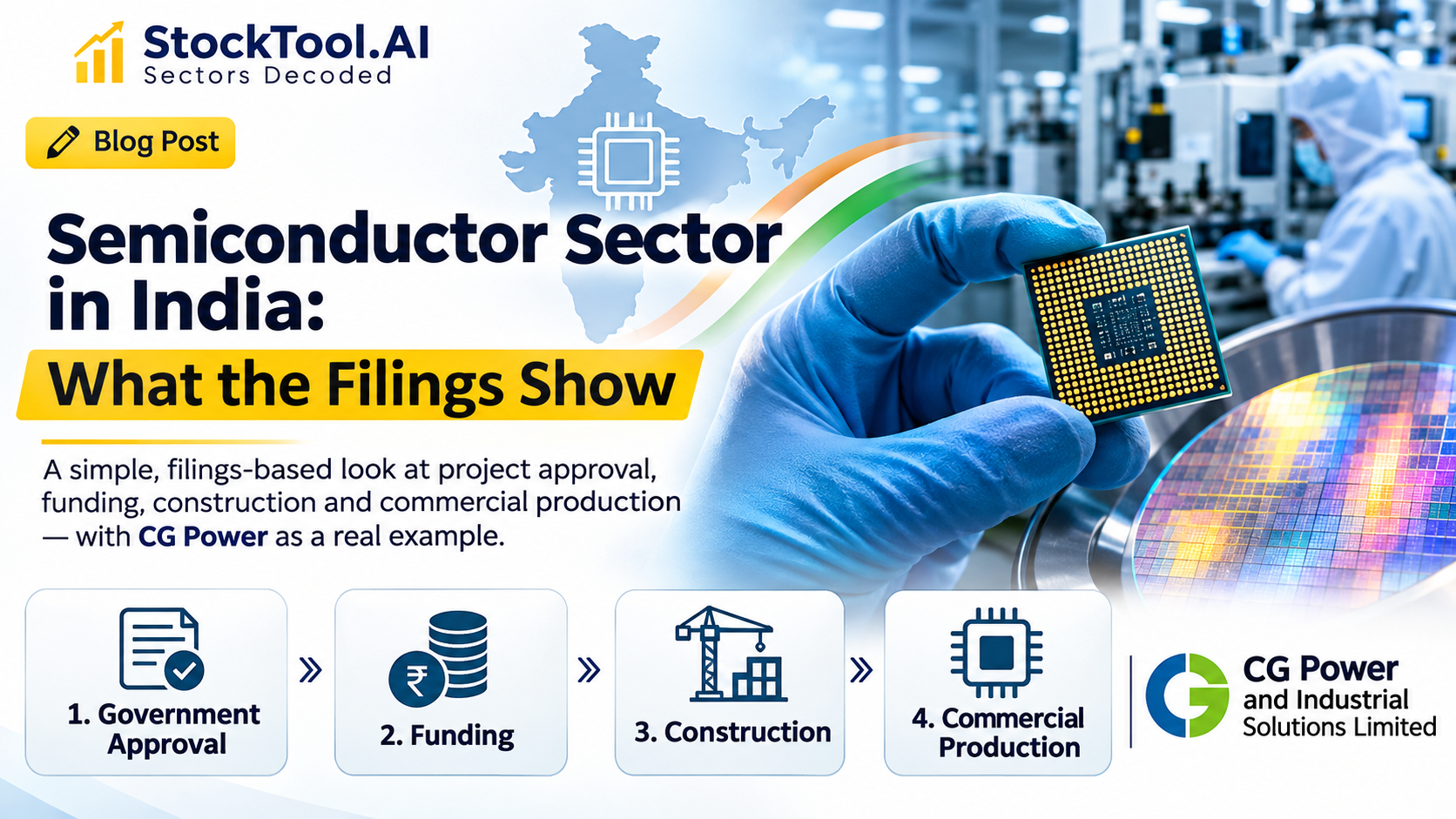
A semiconductor project announcement does not mean chips are being made. To read a listed company’s exposure to the semiconductor sector in India, separate four stages in its filings: government approval, funding, construction and commercial production. Then check the results for semiconductor revenue. CG Power’s filings show each stage.
Start with how much of CG Power is semiconductor business
CG Power and Industrial Solutions Limited reports Semiconductors as a separate segment, beside its Power Systems and Industrial Systems businesses. Its consolidated results for the quarter ended 30 September 2026 were approved by its board on 23 October 2026 and are unaudited. That quarter is the second of FY2027, the financial year from 1 April 2026 to 31 March 2027.
| CG Power, consolidated, ₹ crore | Quarter to 30 Sep 2026 | Six months to 30 Sep 2026 |
|---|---|---|
| Semiconductors: segment revenue | 161.56 | 255.59 |
| Revenue from operations | 3,801.54 | 7,082.35 |
| Semiconductors as a share of revenue (our calculation) | 4.25% | 3.61% |
| Semiconductors: segment result (before tax and interest) | (34.15) | (84.14) |
Source: CG Power, integrated filing (Ind AS), consolidated, quarter ended 30 September 2026, filed with NSE on 23 October 2026: revenue from operations on page 2, segment table on page 10. The filing reports in ₹ lakh; the crore figures and percentages are our arithmetic. Brackets are losses.
So semiconductors already appear as a reported line, but they were about 4% of revenue. Most of CG Power’s revenue in this period came from its other segments, which is why it is a project-tracking example here, not a picture of a semiconductor company.
Segment revenue is not profit. The same table shows the semiconductor segment’s result, its profit or loss before tax and interest, was a loss of ₹34.15 crore for the quarter and ₹84.14 crore for the six months. Our guide to segment results in a filing explains how to read the rest of that table.
What was approved, and what the approval covered
On 29 February 2024, CG Power disclosed to the exchanges that the Union Cabinet had approved its semiconductor unit. The disclosure was made under Regulation 30 of SEBI’s listing rules, which requires a listed company to report material events. It enclosed the government’s press release, which says: “CG Power, in partnership with Renesas Electronics Corporation, Japan and Stars Microelectronics, Thailand will set up a semiconductor unit in Sanand, Gujarat.” It gives an investment of ₹7,600 crore, a capacity of “15 million per day” and chips for consumer, industrial, automotive and power applications.
The covering letter says what kind of unit it is: an Outsourced Semiconductor Assembly and Test facility, or OSAT. The type of facility matters. A fabrication plant, or fab, makes chips on silicon wafers. An OSAT facility takes chips that have already been made and assembles, packages and tests them. Packaging protects the chip and connects it to the wider electronic system; testing checks that it works to specification.
So the CG Power announcement described a project in the assembly and test part of the semiconductor value chain, not a wafer fab. And an approval establishes eligibility under a scheme. It does not establish that the facility has been built, commissioned or has started production. Each of those is a separate milestone that needs its own evidence.
Follow the funding, not just the headline number
The headline investment is one number. The funding behind it comes in later documents. On the earnings call of 29 October 2025, CG Power’s management said the approval for the project’s government support was received on 8 March 2024 and covers five financial years, FY2024-25 to FY2028-29. They gave the figures:
- Total project cost: ₹7,584 crore.
- Central government assistance: ₹3,501 crore.
- Gujarat government support: about ₹1,400 crore, equal to 40% of the central assistance.
- Agreements: a fiscal support agreement signed on 17 January 2025, and a trust and retention account agreement signed on 15 September 2025.
Together the two support amounts come to about ₹4,900 crore, close to two-thirds of the project cost (our arithmetic). Note that the project cost on the call, ₹7,584 crore, is close to but not the same as the ₹7,600 crore in the 2024 announcement: read the latest figure the company gives, and say which document it comes from.
Two terms need defining. A fiscal support agreement sets out the framework for the government’s assistance: how much, on what conditions and when. A trust and retention account is a designated bank account through which a project’s money must flow in an agreed order. Neither means the full support amount has been paid. Whether, and when, money is received, and how much has actually been spent on construction, show up later in the financial statements and their notes.
That spending is capital expenditure, or capex: money spent to build or acquire long-term assets such as land, buildings and machinery. Keep three numbers apart: the announced project cost, the support agreed, and the capex the company has actually recorded. They are related, but they are not interchangeable.
From approval to commercial production: the milestones
The CG Power project shows why a timeline should be read as a sequence of documents, not as one announcement.
| Date | What the source says | What it does not establish |
|---|---|---|
| 29 Feb 2024 | Cabinet approval: Sanand unit, ₹7,600 crore, 15 million per day (company disclosure) | That anything has been built |
| 8 Mar 2024 | Approval of government support received (management, earnings call) | That any support has been paid |
| 13 Mar 2024 | Groundbreaking (government release, July 2026) | Construction progress |
| 17 Jan 2025 | Fiscal support agreement signed (management, earnings call) | Disbursement |
| 28 Aug 2025 | G1 pilot line inaugurated, peak capacity about 0.5 million units a day; G2 under construction, about 14.5 million units a day (government release) | Commercial output |
| 15 Sep 2025 | Trust and retention account agreement signed (management, earnings call) | Disbursement |
| 4 Jul 2026 | Commercial production commenced, 27 months after groundbreaking (government release) | Output, utilisation or full capacity |
Sources: CG Power’s disclosure of 29 February 2024, page 1; the Q2 FY26 earnings call transcript, page 4; the Ministry of Electronics and IT release of 28 August 2025; and its release of 4 July 2026.
The August 2025 release says the chips made on the G1 pilot line would be used for customer qualification, the process in which customers test and approve a supplier’s product before ordering it in volume. It also said G2 was expected to be completed by the end of calendar 2026. The two capacities, 0.5 and 14.5 million units a day, add up to the 15 million in the 2024 approval. That total is planned capacity, not production.
The July 2026 release is the point at which the language can change from “facility under development” to “commercial production commenced”. It is still not evidence of full capacity. None of these documents gives units produced or a utilisation rate, so nobody reading them can say how much of the 15 million a day is in use.
Read the project company and the listed company together
CG Power is the listed parent. On the October 2025 call, management described CG Semi Private Limited as the subsidiary running the Sanand facility. A subsidiary is a company controlled by another company. The project is announced in the subsidiary’s name; its results reach shareholders through the parent’s consolidated results, which combine the parent and its subsidiaries. Our guide to standalone and consolidated results explains why the consolidated figures are the ones to read here.
The two kinds of document answer different questions. The project announcements describe the facility, the partners, the investment and the planned capacity. The consolidated results show what revenue and result the group recorded under the semiconductor segment in a period. Read one against the other.
The next stage of a project like this arrives as an exchange filing: a commissioning update, a results note, a new segment table. StockTool.AI’s exchange filing AI summaries help with the first read. BSE publishes the filing. StockTool.AI’s plain-English summary is live one minute later, with the original source available for verification.
Seven questions for the next semiconductor announcement
- Who is announcing it? The listed parent, a subsidiary, a joint venture or a government body?
- What stage is it? Approval, agreement, construction, pilot line or commercial production?
- What does the money figure mean? Total project cost, government support, or spending already recorded?
- What does the facility do? Fabrication, assembly and test, or design?
- Is the capacity planned or achieved? Look for production and utilisation figures, not only a target.
- Is it in the results? Check segment revenue and segment result, not just the announcement.
- Do the dates line up? A milestone during a quarter may not show up as revenue in that quarter’s results.
Where these filings sit among everything a company sends the exchange is in our guide to every common BSE filing type.
What the filings can and cannot tell you
Read together, CG Power’s disclosure, its results and the government’s releases establish that the project was approved, what it is (assembly and test, not fabrication), what it was planned to cost and to support, when it reached commercial production, and how much semiconductor revenue the group reported afterwards. They do not establish how much the plant is producing, how much of the support has been received, or when it will reach full capacity. Those need their own disclosures.
CG Power appears here as a worked example of tracing a project through its documents, not as a view on the company or its prospects. The discipline carries to any sector: read each announcement for what it says, then look for the later filing that proves the next stage. If you are starting out, our guide to analysing a stock knowing almost nothing is the place to begin, and terms like segment and consolidated are in our beginner’s glossary.
Disclaimer
StockTool.AI is a research and information platform. It is not a SEBI-registered investment adviser or research analyst, and nothing here constitutes investment advice or a recommendation to buy, sell or hold any security.
All insights are AI-generated from publicly available filings, transcripts, annual reports and news. They are summaries, not complete records. They are not exhaustive, and the source document always governs. Information may contain errors or omissions, and data may be delayed or incomplete.
Any investment decision you make is entirely your own. You are responsible for validating every piece of information you rely on against primary sources before acting on it. We accept no liability for any decision taken, or loss incurred, on the basis of anything published here.
Investments in securities markets are subject to market risks. Read all related documents carefully before investing.