
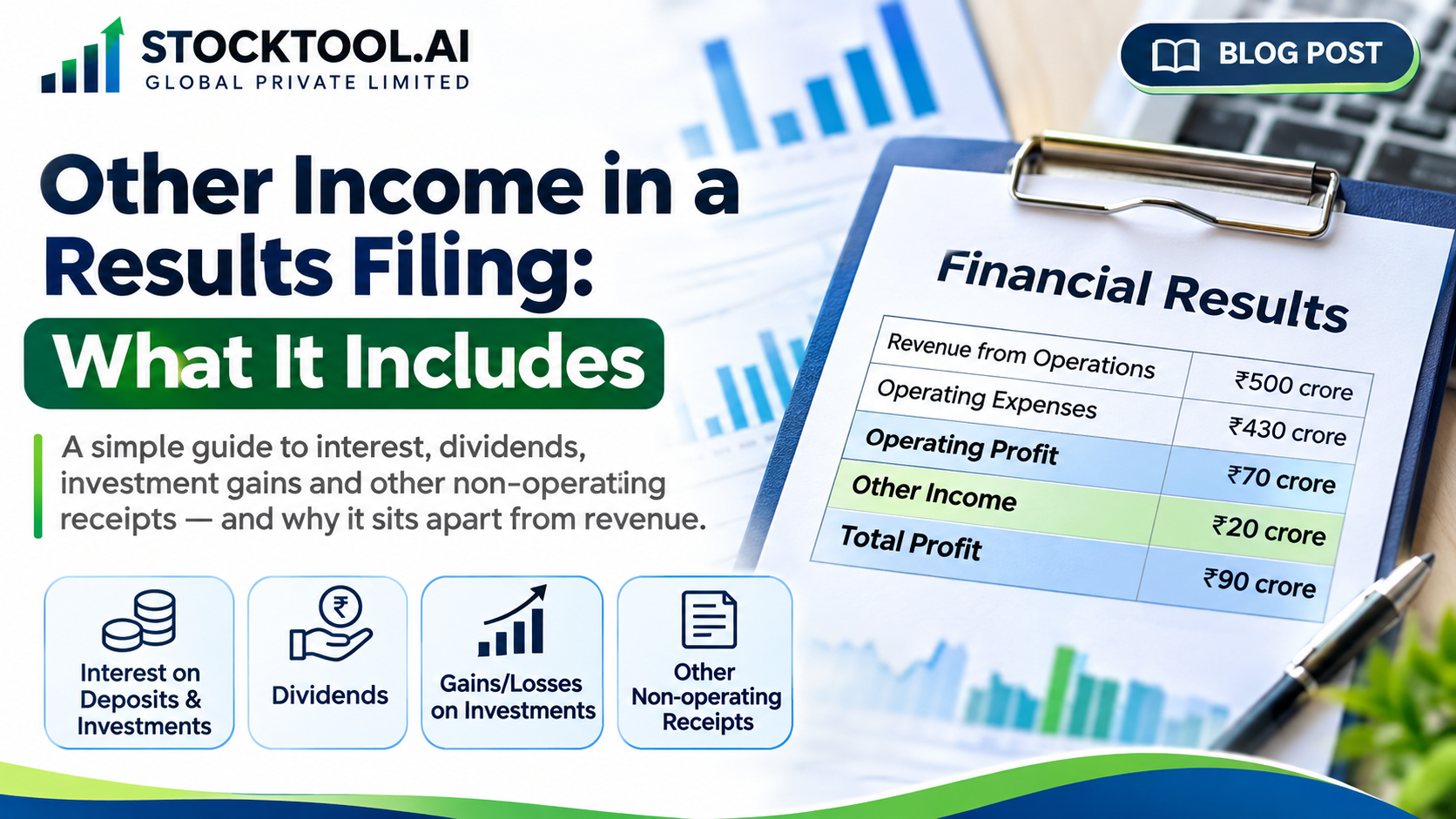
Other income is money a company earns from sources beyond its main business: interest on deposits, dividends, gains on investments and other non-operating receipts. In a results filing it sits on its own line, apart from revenue from operations, because it adds to profit without showing how well the core business did.
That matters when profit rises. Part of the increase may come from interest on surplus cash, a dividend or the sale of an investment rather than from selling more, at better margins. Those amounts are real and part of the result. They are just not evidence that the business itself did better.
Why does other income sit apart from revenue?
Revenue from operations is income from the company’s main activity: selling products for a manufacturer, providing services for a service company. Other income is what it earns outside that activity.
Take a manufacturer that sells equipment and keeps surplus cash in fixed deposits. The equipment sales are revenue from operations. The interest on the deposits is other income. Both reach profit, but they tell different stories: one about customers and demand, the other about the cash the company happens to have.
There is one exception to keep in mind. For a bank or finance company, interest is the main business, so it is revenue from operations, not other income. Always read the line in the context of what the company does.
What does other income include?
For listed companies, which follow Indian Accounting Standards (Ind AS), the format for financial statements is set by Schedule III to the Companies Act, 2013, Division II. It requires other income to be classified as interest income, dividend income, and other non-operating income net of the expenses directly attributable to it. Many companies’ notes go further, with a separate line for gains on investments. In practice, four kinds of item are worth knowing.
1. Interest on deposits and investments
Surplus funds held in fixed deposits, bonds or other interest-bearing instruments earn interest, which appears under other income. A rise may reflect a larger cash balance, higher interest rates or a different mix of deposits; the results statement alone usually does not say which. Compare the figure with the cash and investment balances in the balance sheet, and with earlier periods.
2. Dividends
A company that owns shares in another business may receive dividends from it. Regular dividends from long-held investments are one thing; a single large dividend in one quarter is another. Dividends from subsidiaries also behave differently in the two sets of accounts. In Infosys’s results for the quarter to September 2026, the parent’s standalone other income was ₹1,702 crore against ₹848 crore for the group, and its cash flow statement showed ₹957 crore of dividends received from subsidiaries over the half-year. In the group’s accounts, a dividend paid from one part of the group to another is removed. Our guide to standalone and consolidated results reads that filing line by line.
3. Gains or losses on investments
If a company sells an investment carried in its books at ₹8 crore for ₹10 crore, the ₹2 crore difference may be recognised as a gain, depending on the accounting treatment. That adds to income for the period, but it is not the same as earning ₹2 crore more from products or services. Ask what was sold, and whether such sales are part of the company’s regular activity.
4. Other non-operating receipts
Anything else outside the main business: certain recoveries, compensation received, rent from assets the business does not use, or miscellaneous items. A label such as “miscellaneous income” may cover several small amounts. If the figure is large, look for the explanation in the notes rather than guessing.
Other income belongs beside operating profit, not inside it
Operating profit is the result of the business itself: revenue from operations less the costs of running the business. Imagine a quarter with these figures:
- Revenue from operations: ₹500 crore
- Operating expenses: ₹430 crore
- Other income: ₹20 crore
The business earned ₹70 crore. Add other income and the total is ₹90 crore. The extra ₹20 crore is real, but the company did not earn ₹90 crore from its core business. If last quarter the business earned the same ₹70 crore and other income was ₹5 crore, profit rose by ₹15 crore without the business doing anything differently.
One presentation point. The Ind AS format does not require an operating profit line, so many results do not show one. When a company, a news report or an analyst quotes “operating profit”, check how it was worked out before comparing it with anything else.
Other income is also not the same as an exceptional item. Exceptional items are shown on a line of their own because of their size or nature, and can be gains or charges; our guide to exceptional items in a results filing explains how to read them. A large one-off gain might appear in either place, so read the notes.
How to check whether other income will recur
Start by comparing the figure with the same quarter last year, and with the previous quarter, bearing in mind that some income arrives unevenly. Then open the notes, which may break the total into its parts. Ask of each part:
- Interest: has the cash or investment balance changed?
- Dividends: regular, or tied to one investment or one period?
- Investment gains: was something sold, and is that likely every quarter?
- Other receipts: does the filing say what they are?
Then size it against revenue from operations and profit before tax. A small amount barely moves the result. A large one deserves attention, especially if it explains much of the change in profit.
Do not assume every item is one-off: interest and dividends often recur. Nor assume an item will continue because it has appeared before. The source decides.
Doing this for every company on results day takes time. StockTool.AI’s exchange filing AI summaries help with the first read: BSE publishes the filing, and StockTool.AI’s plain-English summary is live one minute later, with the original source available for verification.
Where to find the details
Use one statement of profit and loss at a time, standalone or consolidated, and compare like with like. Find the “Other income” line, note this period’s figure and the comparative, then find the note that explains it. Results filings sometimes give only a total; the fuller breakdown may be in the annual report, and our guide to reading an annual report shows where the notes sit. Check too whether a comparative has been reclassified or restated, since that changes how the numbers compare. If you are not sure which document you have opened, see every common BSE filing type.
The question to ask of other income
Other income is not good or bad in itself. Interest on surplus cash may arrive every quarter; a dividend may come from an investment held for years; a gain on an asset sale may happen once.
The useful question is not whether it rose or fell, but what produced it, whether it is likely to recur, and how much of the change in profit it explains. Keep revenue from operations, operating profit and other income apart, and the source of a profit change becomes clear. For the order to read a whole results day in, see our results day checklist; terms such as revenue from operations are in our beginner’s glossary.
Disclaimer
StockTool.AI is a research and information platform. It is not a SEBI-registered investment adviser or research analyst, and nothing here constitutes investment advice or a recommendation to buy, sell or hold any security.
All insights are AI-generated from publicly available filings, transcripts, annual reports and news. They are summaries, not complete records. They are not exhaustive, and the source document always governs. Information may contain errors or omissions, and data may be delayed or incomplete.
Any investment decision you make is entirely your own. You are responsible for validating every piece of information you rely on against primary sources before acting on it. We accept no liability for any decision taken, or loss incurred, on the basis of anything published here.
Investments in securities markets are subject to market risks. Read all related documents carefully before investing.